
A piece of furniture shouldn’t merely sit within a room. It should belong to it. For the discerning designer, the search for bespoke bathroom vanity units often begins with a refusal to accept the generic. You’ve likely encountered the frustration of off-the-shelf units that feel flimsy or lack the architectural weight your vision demands. These mass-produced items often fail to support the raw, honest beauty of a custom porcelain slab or the quiet gravity of natural stone. They lack the soul required for a truly high-end space.
We believe a centrepiece requires both sculptural form and structural permanence. This artisan study provides the clarity needed to specify and commission high-end units that integrate seamlessly into the architecture of the home. You’ll gain confidence in selecting between the porous warmth of travertine and the technical precision of porcelain. We’ll also examine the engineering realities of weight and installation. This guide ensures your journey from the initial spark of an idea to the finished, physical object is handled with the gravitas it deserves.
Key Takeaways
- Distinguish between generic made-to-order retail products and true artisan commissions that function as integrated architectural elements.
- Evaluate the tactile, sensory qualities of a travertine vanity unit against the high-performance durability of custom-sized porcelain slabs.
- Gain confidence in specifying bespoke bathroom vanity units by understanding the essential engineering requirements for heavy stone and wall-hung structures.
- Learn how to translate creative mood boards into precise technical specifications that bridge the gap between aesthetic vision and physical reality.
- Identify the nuances of basin selection, comparing the geometric precision of hand-tiled vessels with the flowing lines of organic vessel vessel basins.
The Architecture of the Vanity. Defining Bespoke in 2026.
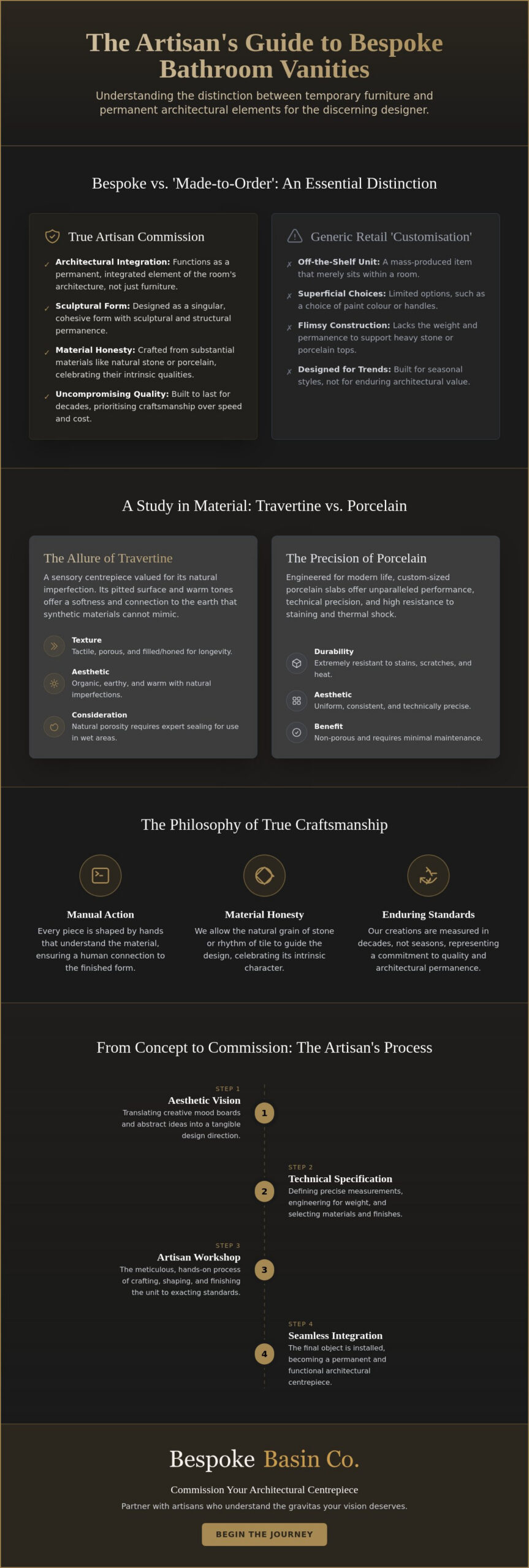
The term bespoke is frequently misused. In the retail world, it often refers to a simple choice of paint colours or a specific handle. This is customisation, not commission. A true artisan study of bespoke bathroom vanity units reveals something far more profound. It is a shift away from furniture that merely sits in a room toward structures that are integral to the building itself. To understand this evolution, one can look at the history of the bathroom vanity, which has transitioned from a simple wooden utility cupboard into a complex architectural anchor.
Intentional design prioritises the relationship between the vessel and the base. They shouldn’t be separate entities joined by a bead of silicone. They’re a singular, cohesive form. In luxury wet rooms, the vanity is now treated with the same weight as a structural wall. It provides a sense of calm and permanence that flimsy, off-the-shelf units cannot replicate. The artisan studio acts as the bridge. It translates the designer’s abstract vision into a physical reality that carries the weight of intention.
For designers seeking high-end fixtures that embody this commitment to quality and form, Milan Gallery Bathroom Vanities provides a selection of premium bathroom furniture that meets the standards of sophisticated architectural spaces.
Beyond Cabinetry. The Sculptural Vanity
Modern luxury demands a move away from furniture with a sink. We’re seeing a return to the tactile. A hand-tiled structure or a solid stone base occupies space with a different kind of authority. It doesn’t rattle when a drawer is closed. It doesn’t flex under the weight of a heavy basin. These units are designed to be permanent. They’re built from materials like natural travertine or high-performance porcelain that age with grace. The aesthetic is one of quiet strength. Texture becomes a language. The way light hits a hand-tiled edge or the cool touch of a honed slab creates a sensory connection that defines the high-end interior.
This commitment to material integrity is shared by leading fabricators; you can discover Richmond Stone to see how precision engineering elevates custom stone features in luxury spaces.
The Artisan Difference
Integrity is found in the details. True artisan work refuses the shortcuts of fast-turnaround retail. Every joint is considered. Every surface is finished by hand. This dedication to slow production ensures that the vision isn’t lost in a factory line. We maintain a workshop feel because personal involvement is the only way to guarantee quality. By avoiding subcontracted labour, the maker stays connected to the object from the first cut to the final installation. It’s a partnership of trust between creator and designer.
- Manual action. Every piece is shaped by hands that understand the material.
- Material honesty. We let the natural grain or tile rhythm speak for itself.
- Enduring standards. Quality is measured in decades, not seasons.
This approach ensures that bespoke bathroom vanity units are more than just storage. They’re a testament to the value of dedicated craft and architectural permanence, a quality also reflected in the custom cabinetry and premium countertop fabrication found in kitchen and bathroom remodelling at cacbydesign.com.
Material Integrity. Porcelain Slabs and Natural Travertine.
The choice of material is an exercise in permanence. For bespoke bathroom vanity units, the transition from painted timber to raw stone or engineered porcelain marks a move toward architectural honesty. It’s about how the surface behaves under light and touch. We distinguish between the uniform and the organic. Choosing a material isn’t just about aesthetics. It’s about how the object will occupy the room for decades. It’s a commitment to substance.
This appreciation for material integrity extends to the kitchen; for those wishing to revitalise existing cabinetry rather than replace it, kitchen cabinet painters denver co offer a specialised refinishing service that mirrors the high-end artisan approach found in bespoke bathroom commissions.
Sustainability is found in the refusal to replace. A well-crafted unit shouldn’t be a temporary fixture. It should be an heirloom. Choosing materials that age with grace is the ultimate sustainable act. Whether it’s the developing patina of stone or the steadfastness of porcelain, these materials outlast the trends of the moment. We focus on the integrity of the slab.
The Allure of Travertine
Natural stone carries a history. The travertine vanity unit has emerged as a sensory centrepiece for those who value imperfection. Its pitted surface and warm, creamy tones offer a softness that cold, synthetic materials cannot mimic. Specifying travertine for high-moisture environments requires an understanding of its porosity. We use filled and honed finishes to ensure longevity whilst preserving the stone’s tactile soul. It’s a connection to the earth. It feels grounded. Designers are returning to these raw textures because they provide a counterpoint to the digital world. It’s a return to the physical. For those working on high-end British projects, our comprehensive guide to the travertine bathroom vanity UK designers specify covers the full spectrum of finishes, structural requirements, and bespoke sizing considerations.
Porcelain Slabs. The Modern Standard
Custom-sized porcelain slabs provide a different kind of precision. They offer unparalleled resistance to staining and thermal shock. This makes them the ideal choice for a high-use family bathroom or a high-traffic commercial suite. Professional designers often cite porcelain slab durability as the primary reason for moving away from traditional ceramics. The material allows for a monolithic look. Large-scale, seamless designs become possible when slabs are expertly mitred and tiled. There’s no grout to discolour. Just a continuous flow of material.
The tactile behaviour of a hand-tiled surface differs fundamentally from a smooth slab. Tiling creates a rhythm. It invites the hand to follow the lines of the grout and the subtle elevations of the tiles. In contrast, a porcelain slab offers a cool, uninterrupted expanse. Both have their place in bespoke bathroom vanity units, depending on whether the design calls for a detailed mosaic or a singular, monolithic block. If you’re beginning to map out a project, you might consider how bespoke tiling can elevate the tactile experience of your space.
Structural Design. Engineering for Weight and Water.
Beauty is heavy. The permanence of bespoke bathroom vanity units relies entirely on what remains hidden beneath the surface. Whilst a standard retail unit might weigh thirty kilograms, a solid stone structure or a fully tiled commission can easily exceed one hundred. This physical gravity requires a shift in thinking. We don’t just design furniture. We engineer architectural interventions. Every millimetre of the internal frame must be calculated to withstand the constant, uncompromising pressure of natural stone and water.
Calculating load-bearing requirements is a precise science. It’s not enough to guess. We look to established structural design standards to ensure safety and serviceability over the long term. This is particularly critical in luxury wet rooms where the floor or wall itself might be subjected to moisture. Managing the plumbing within these solid-surface structures requires a workshop-led approach. We don’t leave it to the site plumber to figure out. We design the voids and access points into the very core of the unit to ensure the vision isn’t compromised by visible pipes or awkward cut-outs.
Wall-Hung Elegance and Engineering
The floating aesthetic is a staple of modern luxury. Achieving it safely requires more than just a few screws. Reinforcing the wall structure is the first step in supporting a custom made bathroom basin. We often utilise concealed steel supports that tie the unit directly into the building’s timber or masonry skeleton. This prevents the sagging or hairline fractures that plague inferior installations. It’s about confidence. A wall-hung unit should feel like a natural extension of the wall itself, immovable and secure. Safety is the silent partner of elegance.
Water Management and Longevity
Water is a destructive force if not respected. Designing for drainage in a bespoke environment means ensuring basins integrate perfectly with standard waste systems without sacrificing the custom look. Standing water is the enemy of stone and tile. Our hand-tiled vessels require specific waterproofing expertise that goes beyond standard bathroom fitting. We apply multiple layers of technical membranes to protect the internal structure from the long-term effects of humidity. This dedication to the “wet” side of design ensures the piece remains as functional as it is beautiful.
Professional installation by our artisan team isn’t optional. It’s the final stage of the making process. Because we built the unit, we understand its unique weight distribution and structural nuances. We don’t trust this delicate final step to subcontracted labour. By handling the installation ourselves, we ensure the integrity of the piece is maintained from the workshop floor to the finished wet room. It’s a continuity of care that guarantees the architectural permanence we promise.
- Steel reinforcement. Hidden frames that carry the burden of stone.
- Technical membranes. Multi-layered protection against moisture ingress.
- Integrated plumbing. Pre-designed voids for a seamless finish.
Specifying for Luxury. A Guide to Custom Commissions.
A commission is a dialogue. For bespoke bathroom vanity units, the process begins long before the first tile is laid or the stone is cut. It starts with a conversation. We translate the ethereal feel of a designer’s mood board into the rigid, uncompromising language of technical specifications. This isn’t a simple “add to cart” transaction. It’s a move from the abstract to the physical. We define the unique flow of the room, ensuring the dimensions serve the space rather than crowding it. Every millimetre is intentional.
Selecting the basin type is a pivotal decision in the design journey. You might opt for the geometric precision of hand-tiled vessels or the soft, flowing lines of organic vessel basins. Each choice dictates a different structural response from the vanity base. During the prototyping phase, we provide material samples to ensure the tone of the travertine or the finish of the porcelain meets the exact requirements of the site. This ensures there are no surprises when the final piece arrives. It’s about certainty.
Form Follows Function
A vanity should not be a compromise. We balance the necessity of storage with the desire for a minimalist, sculptural form. You must decide whether an integrated basin serves the vision or if a countertop vessel provides the required height and presence. The impact of lighting cannot be overstated. The direction of a sconce or the warmth of a backlit mirror can dramatically alter the shadows cast by the texture of a hand-tiled vanity. We look at the piece as it will exist in situ. It’s a plinth for daily rituals.
The Specification Timeline
Artisan craft requires patience. Lead times for these pieces typically range from six to eight weeks for natural structures, extending to ten weeks for complex hand-tiled commissions. This reflects the slow, intentional nature of the workshop. We don’t rush the curing of membranes or the setting of stone. Coordination with on-site contractors is essential to ensure the structural reinforcements are ready for the arrival of the unit. The commission phase is a dedicated partnership between maker and client that ensures the final object carries the weight of the original vision. If you’re ready to begin this process, you can commission your bespoke vanity unit through our studio.
- Initial Consultation. Translating mood boards into technical drawings.
- Material Approval. Reviewing samples of travertine or porcelain in the correct light.
- Prototyping. Confirming dimensions and plumbing access points.
- Workshop Phase. The slow making of the structural frame and finish.
The Artisan’s Workshop. Bespoke Basin Co. Philosophy.
The workshop is a place of quiet focus. It’s where the abstract becomes physical. We refuse off-the-shelf retail products because they’re built for speed, not for life. They’re designed to fit a box, not a home. Our philosophy is rooted in the belief that bespoke bathroom vanity units should be treated as permanent architectural features. We don’t settle for “good enough.” Every piece that leaves our studio is a testament to the value of patience and the raw honesty of manual labour.
Our “slow making” process is a deliberate rejection of the temporary. It results in objects that carry a sense of gravity and history from the moment they’re installed. The sensory journey begins with the selection of a raw porcelain slab or a block of natural stone. We feel the weight. We observe the grain. From the first precise cut to the final, meticulous hand-tiling, the maker remains connected to the material. This continuity ensures that the finished bathroom centrepiece isn’t just a utility. It’s a sculptural anchor for the room.
A Commitment to Mastery
Integrity cannot be outsourced. We explicitly avoid subcontracted labour to maintain our uncompromising standards. A master artisan oversees every tile, joint, and seal. This personal involvement is the only way to ensure the vision is realised exactly as intended. We’re proud to uphold the legacy of British craftsmanship in a contemporary context, a commitment to quality also demonstrated by Finest Furniture Studio in their bespoke fitted furniture and wardrobe solutions. By keeping every stage of production and installation in-house, we protect the structural and aesthetic soul of the work. It’s a matter of pride. We don’t just ship a product; we deliver a standard of quality that we’re prepared to stand by for a lifetime.
Your Next Project
Beginning the conversation for a bespoke interior is an act of intent. It’s a move toward a more thoughtful way of living. Investing in hand-crafted sanitaryware provides an enduring value that mass-produced items can never replicate. The texture of the stone and the precision of the fit will be appreciated every single day. We invite you to move beyond the generic and explore the possibilities of a truly custom commission. The dialogue between maker and designer is where the most exceptional spaces begin. It’s time to create something that belongs.
Enquire about your bespoke vanity commission today and begin the journey toward architectural permanence.
- No subcontractors. We handle every stage of the process ourselves.
- Slow making. We prioritise depth and quality over production speed.
- Material focus. We let the raw beauty of stone and porcelain lead the design.
- British craft. Traditional skills met with modern architectural needs.
Creating a Legacy of Architectural Permanence
The transition from generic furniture to bespoke bathroom vanity units is a commitment to substance. It’s about moving beyond the temporary to create a centrepiece that feels like an integrated part of the architecture. We’ve explored how the honest textures of travertine and the precision of porcelain slabs provide a sensory connection that retail items can’t match. True luxury isn’t found in a catalogue. It’s found in the engineering of weight and the slow, intentional making of a singular form.
Our artisan studio operates on slow-making principles to ensure every joint and surface meets an uncompromising standard. We refuse subcontracted labour. We handle every stage personally, including in-house professional installation, to ensure the original vision remains intact from the workshop to the wet room. This continuity of care is what defines a true commission. It ensures that the object you’ve envisioned becomes a physical reality that will endure for a lifetime.
Commission your bespoke bathroom vanity unit today and let’s discuss how to anchor your next project with quiet, understated confidence. Your vision deserves the integrity of dedicated craft.
Frequently Asked Questions
How much weight can a wall-hung bespoke bathroom vanity unit safely hold?
Wall-hung bespoke bathroom vanity units can safely support over one hundred kilograms when properly engineered. We achieve this by tying concealed steel supports directly into the building’s masonry or timber skeleton. This structural reinforcement prevents sagging and ensures the unit remains immovable. It is essential to calculate these load-bearing requirements during the design phase to meet building control approval for significant alterations.
What is the typical lead time for a hand-tiled vanity unit commission?
Typical lead times for artisan commissions range from eight to ten weeks. This duration reflects our “slow making” philosophy and the time required for technical membranes to cure and stone to be precisely cut. Hand-tiled commissions often sit at the upper end of this scale due to the intricate nature of the work. We prioritise depth of quality over production speed to ensure each piece lasts a lifetime.
Can bespoke porcelain vanity units be repaired if chipped?
Porcelain can be repaired using specialist colour-matched resin fillers. Once cured and polished, these repairs are virtually invisible to the naked eye. For more significant damage, the structural integrity remains unaffected, though prevention through careful handling is always preferred. The dense nature of custom-sized porcelain slabs makes them far more resistant to impact than traditional ceramic alternatives.
Are travertine vanity units difficult to maintain in a family bathroom?
Travertine requires a specific maintenance routine but is perfectly suited for family environments when correctly specified. We use filled and honed finishes that reduce porosity and prevent moisture ingress. Regular sealing, typically once every twelve to eighteen months, preserves the stone’s tactile soul and protects it from staining. It is a material that ages with grace, developing a soft patina that adds to the room’s character. For a detailed technical overview of how to specify and maintain a travertine bathroom vanity UK designers trust for high-end homes, our dedicated resource covers every consideration in depth.
Do you provide installation for bespoke basins across the entire UK?
We provide in-house professional installation to ensure the integrity of the vision is realised. By avoiding subcontracted labour, we maintain total control over the structural and aesthetic finish of the project. While our studio is based on artisan principles, we coordinate the logistics of delivery and fitting for each commission. Please contact the workshop to discuss the specific requirements of your location. For clients in North and West Yorkshire, Kobb Interiors Ltd offers expert installation of bespoke bathroom furniture; to learn about their flexible payment plans, read more.
Can I use my own tiles for a bespoke hand-tiled vessel basin?
You can specify your own tiles for a hand-tiled vessel basin as part of the commission process. This allows for a seamless aesthetic where the basin perfectly matches the surrounding wall or floor surfaces. We review the technical properties of your chosen tiles to ensure they are suitable for the multi-layered waterproofing membranes we apply in the workshop. It is a collaborative design journey.
What is the difference between a custom-sized porcelain slab and a standard tile?
The primary difference lies in the scale and the resulting lack of grout lines. A custom-sized porcelain slab allows for a monolithic, seamless appearance that standard tiles cannot achieve. Standard tiles create a rhythmic pattern of grout, whereas a slab offers a cool, uninterrupted expanse of material. Slabs are also technically superior in high-use environments due to their resistance to discolouration and thermal shock.
How do bespoke bathroom vanity units handle integration with existing plumbing?
Bespoke bathroom vanity units are designed with pre-calculated voids to integrate with existing plumbing whilst ensuring compliance with Part F ventilation standards. We plan for the necessary extraction rates of 15 litres per second required by the 2026 edition of Approved Document F. This workshop-led planning ensures that no pipes are visible and no awkward cut-outs are required on-site. It is an architectural intervention.