
The most enduring interiors are those that embrace the raw honesty of the natural world. A travertine bathroom vanity UK designers specify is more than furniture. It is a geological narrative. It’s a testament to the slow, deliberate work of time and water. You likely appreciate the tactile warmth of this stone but perhaps hesitate at the practicalities. The fear of porosity or the structural weight on traditional timber floorboards often stalls a project before it begins. These are valid concerns. They deserve honest, technical answers.
This resource serves as a comprehensive guide to the architectural value and specification of travertine for high-end British homes. You’ll gain a deep understanding of how various finishes respond to daily use and how to commission bespoke sizing for non-standard layouts. We will examine the artisan craftsmanship required to transform raw slabs into permanent fixtures. We’ll also address the structural requirements for wall-hung units and floor-standing pieces. By the end, you will have the confidence to specify this material as a lasting investment in both form and utility.
Key Takeaways
- Understand the geological origins of travertine and why its unique sedimentary structure offers a sense of permanence to high-end British interiors.
- Distinguish between honed, tumbled, and polished finishes to select the tactile quality that best complements your specific lighting and design aesthetic.
- Learn how to specify a bespoke travertine bathroom vanity UK project by addressing structural floor requirements and the inherent strength of properly installed stone.
- Navigate the technical journey of a custom commission, from initial sizing for non-standard spaces to the final, hand-finished installation.
- Discover the functional advantages of working directly with an artisan studio to ensure your vanity is a precise architectural fit for your home.
The Timeless Appeal of the Travertine Bathroom Vanity in the UK
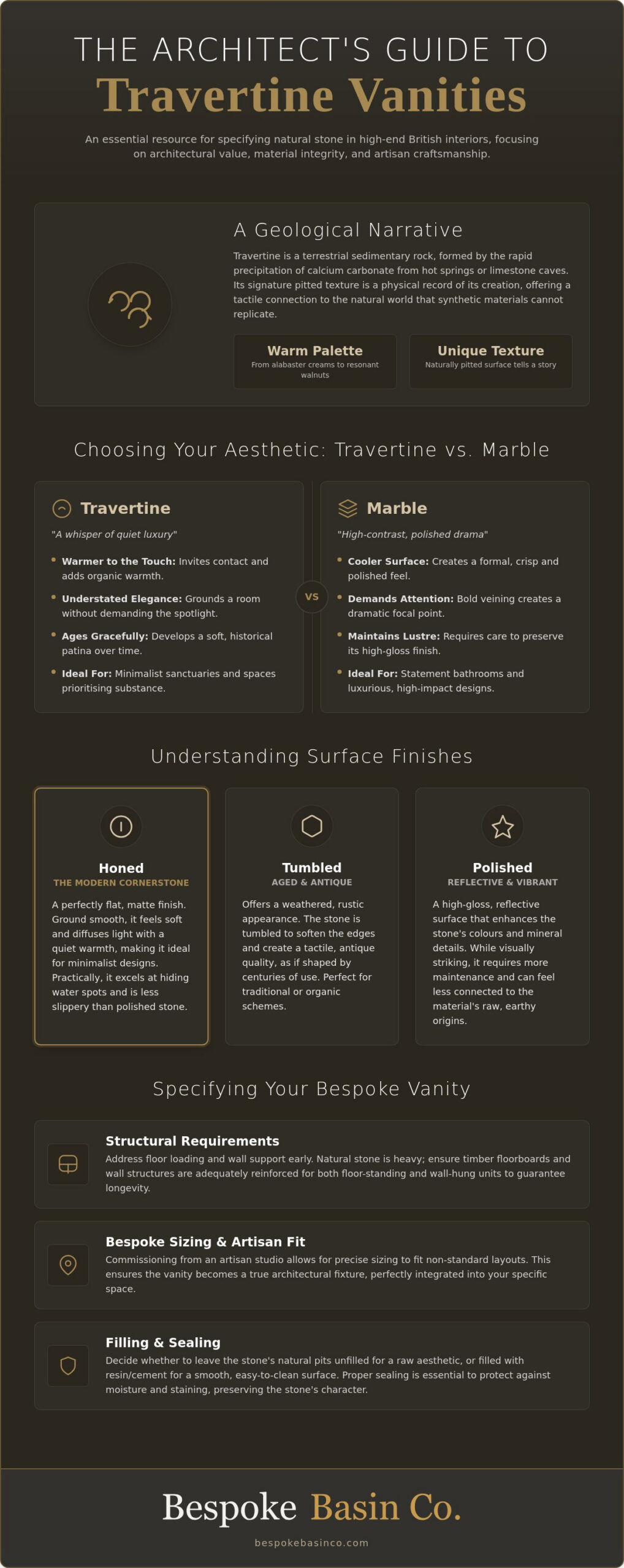
The most enduring interiors are those that prioritise substance over flashiness. A travertine bathroom vanity UK designers specify is more than a functional object; it is an anchor. It doesn’t shout. It rests. Travertine is a terrestrial sedimentary rock, formed by the rapid precipitation of calcium carbonate at the mouth of hot springs or within limestone caves. This origin story is etched into every vein. It provides a tactile connection to the earth that synthetic resins or mass-produced ceramics simply cannot replicate. In the context of the high-end British home, this material represents a commitment to the raw honesty of natural materials.
A Geological Narrative for Modern Bathrooms
The signature pitted texture of the stone is a record of movement. As carbon dioxide bubbles escaped during the stone’s formation, they left behind a network of small cavities. Some designers choose to leave these unfilled for a rustic, honesty-driven aesthetic, whilst others prefer them filled and honed for a seamless finish. The colour palette is equally intentional. It spans from the softest alabaster creams to deep, resonant walnuts. These shades don’t compete with a room; they ground it. Travertine is a material of geological history and architectural weight.
Travertine vs. Marble. Choosing Your Aesthetic.
Marble is a material of high-contrast drama and cold, polished surfaces. It demands the spotlight. Travertine offers a different narrative. It is a whisper. It represents a “quiet luxury” that feels more at home in the understated, high-end UK bathroom. This stone is naturally warmer to the touch than marble or granite. It invites contact. For those seeking an organic, minimalist sanctuary, a bespoke bathroom vanity unit serves as a functional sculpture. It creates a focal point that feels evolved rather than manufactured.
Longevity is found in the way a material behaves over time. Synthetic surfaces often degrade or lose their lustre, yet natural stone evolves. Travertine ages with a grace that few other materials can claim. It develops a soft patina. It absorbs the history of the home. This sense of permanence is why a travertine bathroom vanity UK project remains a cornerstone of sophisticated design. It bridges the gap between the ancient world and the modern workshop through a narrative of patience and dedication.
Aesthetic Nuances: Honed, Tumbled, and Polished Finishes
Texture defines the emotional weight of a room. When specifying a travertine bathroom vanity UK designers must consider how the stone’s surface interacts with the unique, often diffused light of a British interior. Different treatments alter the stone’s character entirely. A polished finish is high-gloss and reflective. It enhances the vibrant colours of the minerals but can feel somewhat detached from the raw origins of the material. In contrast, the tumbled finish offers a weathered, aged appearance. The edges are softened and the surface is left with a tactile, antique quality that feels as though it has been shaped by centuries of water flow.
Choosing the right finish isn’t just about appearance. It’s about how the object occupies space. A finish should complement the broader scheme, whether that is the sharp lines of a contemporary wet room or the softer textures of a traditional suite. The surface treatment dictates how the stone will age and how it will feel against the skin during a morning ritual.
The Tactile Integrity of the Honed Surface
Honed travertine is the cornerstone of modern, minimalist design. It is ground to a perfectly flat, matte finish that removes the shine but retains the smoothness. It feels soft. It feels grounded. This finish is particularly effective in bathrooms where moisture is constant. It lacks the slippery, high-maintenance glare of polished stone. Instead, it diffuses light. When paired with soft, recessed lighting, a honed surface glows with a quiet warmth. It is also a practical choice. It hides water spots and minor mineral streaks, ensuring the unit looks intentional and well-kept between cleans.
Filling and Sealing. Preserving the Stone’s Character.
The natural pits and voids of travertine are its fingerprint. You must decide whether to embrace these or smooth them. Filled travertine uses a cement or resin to plug these cavities, creating a solid surface that is easy to wipe down whilst preserving the visual interest of the stone’s structure. Unfilled travertine is more daring. It celebrates the raw, geological history of the material. However, both require protection. According to the Natural Stone Institute technical bulletin, the stone’s sensitivity to acidic substances and its inherent absorption rates mean that a high-quality sealant is essential. This barrier protects against staining without masking the stone’s natural breathability.
Maintaining this integrity doesn’t have to be complex. It simply requires a consistent approach. For those investing in a permanent fixture, our travertine vanity maintenance guide offers specific advice on preserving the artisan surface. If you are beginning your design journey, selecting a Travertine Vanity Unit with the correct finish is the first step toward a bathroom that feels both timeless and deeply personal.
Durability and Practicality: Addressing the Softness of Natural Stone
The common misconception that travertine is too fragile for the rigours of a bathroom often stems from its classification. It is a softer stone than granite, certainly. However, softness is not synonymous with weakness. When properly specified and installed, a travertine bathroom vanity UK homes feature can last for generations. Its strength lies in its density and the way it handles the passage of time. Unlike synthetic surfaces that show every micro-scratch with glaring clarity, the natural variations, veining, and pits of travertine help to disguise the minor marks of daily life. It’s a material that doesn’t just survive use; it matures with it.
Success with natural stone is a matter of education. As highlighted in the Natural Stone Institute’s guide to travertine, this material is a specific form of limestone. This means it’s chemically sensitive to acids. It isn’t a flaw. It’s a characteristic. Understanding this allows a designer to create spaces that respect the material’s integrity whilst benefiting from its immense structural permanence. Travertine rewards the patient owner. It is a relationship between maker, material, and user that prioritises long-term value over temporary convenience.
Managing Porosity and Chemical Sensitivity
Acidic substances are the primary concern for any natural stone surface. Common bathroom items like citrus-based soaps, certain perfumes, or aggressive descalers can etch the surface, leaving dull spots. The solution is simple. Use pH-neutral cleaners specifically formulated for stone. This preserves the sealant and the stone beneath it. Consider these daily habits to maintain the surface beauty:
- Blot, don’t wipe. If a spill occurs, blot it immediately to prevent the liquid from entering the pores.
- Use stone-safe trays. Place glass bottles or metal canisters on small trays to avoid mineral rings or scratches.
- Rinse after use. A quick rinse with plain water after using toothpaste or heavy soaps prevents residue build-up.
Longevity through Artisan Craftsmanship
The durability of a unit is determined long before it reaches the home. It begins in the workshop. The quality of the initial cut and the precision of the finish impact how the stone handles moisture and weight over decades. Mass-produced retail units often prioritise speed, resulting in thinner slabs or poor-quality fills that can degrade under the humid conditions of a British bathroom. A bespoke commission ensures the stone is handled with the dedication it deserves. For a deeper look into the technical requirements of these pieces, consult our designer’s guide to bespoke bathroom vanity units. This artisan approach guarantees that your travertine bathroom vanity UK project is built for permanence, not just for the present.
Specifying Your Vanity: Dimensions, Weight, and Structural Requirements
Precision is the hallmark of a successful travertine bathroom vanity UK installation. It requires a shift from the abstract to the physical. When working within the constraints of British architecture, particularly in period properties or compact urban flats, every millimetre matters. An off-the-shelf unit often fails to respect the specific geometry of an alcove. A bespoke approach allows the stone to sit flush, creating a sense of architectural intent. Early coordination with your plumber and installer is not just recommended; it is vital. It ensures that waste alignment and pipework are concealed within the unit’s structure rather than becoming an afterthought.
The specification process is a dialogue between the designer and the maker. It involves a clear understanding of how the object will occupy the space. You must consider the swing of a door, the height of existing pipework, and the proximity to other fixtures. When these elements are ignored, the installation feels forced. When they are respected, the stone appears as though it grew from the wall itself. This level of detail is what separates a standard renovation from a truly considered interior.
Calculating the Weight of Natural Stone
Travertine is dense. A standard slab used for a vanity top can weigh significantly more than its ceramic or timber counterparts. For a wall-hung design, the structural integrity of the wall is paramount. Hollow stud walls often require the addition of a supportive batten frame or a reinforced plywood pattress behind the finish. Floor-standing units, whilst easier to support, still exert a concentrated load on floor joists. In older UK homes, it’s prudent to have a structural engineer or a knowledgeable builder assess the joist direction and spacing. This ensures the floorboards won’t deflect under the permanent weight of the stone. Estimating the volume of the stone early allows you to provide your contractor with the necessary data to reinforce the subfloor or wall structure before the tiling begins.
Integration with Bespoke Basins
The dialogue between the vanity surface and the vessel it holds defines the final aesthetic. There is a deep harmony in pairing a stone surface with a custom made bathroom basin. This pairing allows for precise tap hole drilling and waste alignment that mass-market products cannot offer. You must specify the tap centres and the spout reach with absolute accuracy to prevent splashing and ensure ergonomic comfort. This technical foresight ensures the water lands exactly where intended. Precision in specification is the difference between a product and a permanent fixture.
If you are ready to move from concept to technical drawing, you can explore our bespoke travertine vanity options to begin the specification process. Taking the time to get the dimensions and structural requirements right ensures that the final piece is as functional as it is beautiful.
The Artisan Commission: Crafting Your Bespoke Travertine Vanity
Commissioning a travertine bathroom vanity UK designers can trust is an exercise in patience. It is a shift away from the “add to cart” culture of modern retail. A commission is a partnership. It is a dialogue between the architect’s vision and the artisan’s understanding of the material. Unlike mass-market units that arrive in a box, a bespoke piece is born in the workshop. It is shaped by the specific requirements of your home and the unique characteristics of the stone itself. This “slow making” philosophy ensures that the final result is not just a product, but a permanent fixture of your sanctuary.
Working directly with an artisan studio offers a level of control that retailers cannot match. You aren’t limited to standard widths or pre-drilled tap holes. Instead, you have the opportunity to specify the exact tactile quality of the finish and the precise orientation of the veining. This commitment to uncompromising quality extends through to our in-house installation. We believe that the person who crafted the stone is best equipped to ensure it sits perfectly within its architectural context. It is a seamless journey from the raw block to the finished room.
The Workshop Process: From Slab to Sanctuary
The process begins with the selection of the raw travertine slab. We look for a narrative in the stone. The veining must have a rhythm that complements the intended scale of the vanity. Once selected, the manual action begins. We cut. We hone. We finish. Each movement is deliberate. The artisan develops a personal connection with the stone, sensing its density and responding to its natural voids. This hands-on approach allows us to celebrate the geological history of the material whilst ensuring it meets the rigorous standards of a high-end British interior. The result is a surface that feels alive.
Commencing Your Bespoke Project
Every project starts with a conversation. In the collaborative design phase, we translate your ideas into technical drawings that account for every waste pipe and wall bracket. This precision prevents the common pitfalls of stone installation in older properties. You must account for lead times. High-end, hand-crafted work cannot be rushed. It requires a dedicated period of production where the stone is allowed to be worked with the necessary care. This timeline is an investment in the longevity and the integrity of the piece.
If you are ready to move beyond the generic and invest in a piece that reflects your dedication to quality, we invite you to contact the studio for a consultation. We are here to guide you through the nuances of natural stone and help you create a focal point that will endure for generations.
Creating a Permanent Architectural Legacy
Choosing a travertine bathroom vanity UK designers specify is a commitment to a specific standard of quality. It is a rejection of the temporary in favour of the enduring. We have explored the geological narrative of the stone, the tactile nuances of honed and tumbled finishes, and the rigorous structural requirements necessary for a successful installation. These elements work together to transform a bathroom into a sanctuary. When you prioritise architectural-grade materials and precise specification, the result is a fixture that ages with grace and integrity.
Every piece we create is hand-crafted in our dedicated UK workshop. We manage the entire journey from the selection of the slab to the expert in-house installation. This ensures that the artisan’s vision is preserved until the moment the stone meets your wall. If you are ready to move away from mass-produced retail and toward a truly considered interior, we invite you to discuss your bespoke travertine commission with our artisan studio. Your project deserves the focus and dedication of a master maker. We look forward to helping you ground your home in the raw honesty of natural stone.
Frequently Asked Questions
Is travertine suitable for a high-traffic family bathroom?
Travertine is an excellent choice for family bathrooms provided you embrace its specific maintenance requirements. It is a dense, durable material that survives the rigours of daily life with ease. Its natural variations are particularly effective at disguising minor wear. However, success depends on the quality of the initial seal and the consistent use of appropriate cleaners. It’s a material that rewards those who value longevity over temporary convenience.
How do I prevent staining on my travertine vanity top?
Prevention is rooted in the initial workshop process and subsequent sealing. A high-quality impregnating sealer creates a barrier within the stone’s pores to repel liquids. You should also adopt the habit of blotting spills immediately rather than wiping them. Using stone-safe trays for perfumes and soaps prevents mineral rings. These simple actions preserve the integrity of your travertine bathroom vanity UK project for years.
Can I install a wall-hung travertine vanity on a stud wall?
You cannot install a heavy stone unit directly onto a standard hollow stud wall. The weight of travertine requires a reinforced structure. This usually involves adding a supportive batten frame or a thick plywood pattress behind the wall finish. It is essential to coordinate this structural work with your builder early in the renovation phase. This ensures the unit remains a permanent, secure fixture.
What is the difference between filled and unfilled travertine?
Filled travertine has its natural geological pits plugged with a colour-matched resin or cement. This creates a smooth, continuous surface that is easier to wipe clean. Unfilled travertine celebrates the stone’s raw history by leaving these cavities open. Whilst unfilled stone offers a more tactile, architectural aesthetic, it requires more careful cleaning to prevent soap residue from settling in the voids. The choice depends on your preference for ease versus texture.
How often should a travertine bathroom vanity be resealed?
A travertine surface typically requires resealing every one to two years. This timeframe depends on the frequency of use and the harshness of your cleaning routine. You can test the integrity of the seal by dropping a small amount of water on the surface. If the water beads, the seal is intact. If it absorbs and darkens the stone, it’s time for a fresh application to maintain the barrier.
Does travertine change colour over time?
Travertine doesn’t undergo a radical colour shift, but it does evolve. Like all natural materials, it develops a soft patina as it interacts with light and use. This subtle maturation is not a defect. It is a sign of the stone’s authenticity. This process adds a layer of depth and character that synthetic materials cannot replicate. It contributes to the room’s sense of permanence and history.
Can I use standard bathroom cleaners on my travertine surface?
Standard cleaners are often too aggressive for natural stone. Many retail products contain acidic agents or bleach that will etch the surface and strip away the protective sealant. This leaves the stone vulnerable to staining and dullness. You must use pH-neutral cleaners specifically designed for travertine. These products clean effectively without compromising the stone’s chemical integrity or its tactile finish. Proper care ensures the material’s longevity.
What is the typical lead time for a bespoke travertine commission in the UK?
Lead times for a bespoke travertine bathroom vanity UK commission are dependent on the complexity of the design and our current workshop schedule. Artisan production is a methodical process that refuses to cut corners. We prioritise the integrity of the final piece over the speed of delivery. This ensures that every unit we finish meets our uncompromising standards of craftsmanship. We believe quality work deserves the gift of time.