
A bathroom should not be a collection of generic fixtures. It is a sanctuary. The most intimate spaces in an architectural scheme deserve more than the flimsy uniformity of a retail catalogue. They require the quiet permanence of natural materials. They demand the intentional touch of a human hand. When specifying bespoke basins for commercial interiors, you likely understand the frustration of units that feel lightweight or lack sensory depth. Finding the right texture amongst a sea of plastic-smooth surfaces is a constant challenge for the modern designer.
This artisan guide explores how organic vessel basins redefine luxury through hand-crafted geometry and material honesty. You will discover how to move beyond off-the-shelf limitations to create a centrepiece that evokes a genuine sense of calm. We will examine the workshop philosophy where every curve is a deliberate choice and every surface is designed to age with grace. From custom-sized porcelain slabs to the tactile nature of hand-tiled vessels, we explore sanitaryware that fits perfectly within a considered architectural scheme.
Key Takeaways
- Learn why UK interior design is shifting away from clinical, rigid forms toward the asymmetrical, fluid silhouettes of the natural world.
- Understand the technical precision required to translate soft curves into permanent porcelain structures that retain their structural integrity.
- Discover the sensory power of hand-tiled surfaces and how their unique textures interact with light to create a centrepiece with physical depth.
- Master the nuances of specifying bespoke basins for commercial interiors, from determining the perfect scale to ensuring seamless tap placement.
- Recognise the importance of the workshop philosophy and why in-house manufacture is the only way to guarantee the longevity of an artisan object.
Defining the Organic Vessel Basin. A Departure from the Rigid.
Form follows feeling. For too long, sanitaryware has been defined by the harsh geometry of the production line. Sharp angles. Clinical whites. Rigid symmetry. An Organic Vessel Basin represents a fundamental departure from this mechanical aesthetic. It is a form inspired by the asymmetrical silhouettes found in the natural world, such as a weathered stone or a river-worn pebble. Unlike standard retail options, these objects don’t seek to dominate a room with aggressive lines. They settle into it. They offer a sense of quiet permanence.
The UK interior design market is witnessing a significant shift. Designers are moving away from the sterile environments of the past toward spaces that feel human and grounded. There is a profound psychological benefit to soft curves in a room dedicated to ritual and cleansing. Sharp edges create subconscious tension; fluid forms invite relaxation. It’s important to distinguish between a simple round basin and a true organic vessel. A round basin is a geometric calculation. An organic vessel is an artistic interpretation. It possesses a weight and a presence that mass-produced items cannot mimic. The specification of bespoke basins for commercial interiors is no longer about selecting from a catalogue; it’s about commissioning a piece of architectural history.
The Bathroom Centrepiece. An Evolution of Form.
The historical development of the modern basin shows a steady move from purely functional necessity to a high-end architectural focal point. In the past, the sink was a hidden utility. Today, it anchors the entire aesthetic of a wet room. When specifying bespoke basins for commercial interiors, the goal is often to create a sensory experience for the end-user. We see a growing demand for tactile materials that invite touch. A hand-tiled vessel or a custom-sized porcelain slab offers a depth of character that standard ceramic simply lacks. It transforms a routine action into a moment of connection.
Biophilic Design. The Vessel as Nature.
Nature is never perfectly straight. Biophilic design recognises that integrating natural shapes into our built environment can significantly reduce stress and improve well-being. The organic vessel basin serves as a primary tool in this interior scheme. It acts as a visual bridge between the raw outdoors and the refined indoors. Whilst modern design is often transient and trend-led, these artisan-made objects prioritise longevity. They are built with the integrity of the maker in mind. They aren’t just fixtures. They are permanent art. Every bespoke tiled basin we create is a testament to this philosophy of slow making.
The Geometry of Nature. Understanding Fluid Form in Porcelain.
Nature does not work in blueprints. It works in forces. To translate the soft, undulating curves of a riverbed into a functional object requires more than a simple mould. It requires an intimate understanding of how porcelain behaves under tension. Standard geometric basins rely on the predictability of straight lines and uniform thickness. Organic forms, however, demand a higher level of manual skill to execute. The artisan must manage the visual weight of the vessel, ensuring that its asymmetrical profile finds a perfect, stable balance upon the vanity unit. It is a process of constant adjustment. A dialogue between the maker and the material.
Structural integrity is the silent partner of beauty. Whilst a basin may appear delicate and fluid, its construction must be uncompromising. In the context of bespoke basins for commercial interiors, this durability is paramount. These objects must withstand the rigours of high-traffic environments whilst maintaining the quiet elegance of a gallery piece. Every curve is a calculation of strength. Every taper is a study in permanence. We do not aim for the perfection of a machine; we aim for the integrity of a well-made object.
The Artisan Process. From Idea to Object.
The workshop is a place of patience. We reject the haste of the modern production line. At Bespoke Basin Co., we avoid off-the-shelf retail moulds because they represent a compromise on form. They are generic. They lack the soul of a commissioned piece. Our process is rooted in a “slow making” philosophy, where hand-finishing is a continuous part of the journey. This hands-on involvement allows us to create one-of-a-kind vessels that possess a unique thumbprint of their creation. It is the difference between an object that is manufactured and one that is made.
Material Integrity. Porcelain and the Senses.
Material choice dictates the lifespan of the design. We utilise custom-sized porcelain slabs because they offer unparalleled resistance to staining and wear. Unlike concrete, which can feel cold and industrial, hand-worked porcelain has a warmth and a tactile richness. It invites the hand to follow its contours. By using larger porcelain slabs, we can achieve more ambitious organic forms without the need for unnecessary joins. This continuity of surface is what defines a truly premium object. When specifying bespoke basins for commercial interiors, the choice of material is as critical as the shape itself. It determines how the object will age and how it will be perceived by those who use it.
Designers seeking to anchor their schemes with these sculptural elements often find that commissioning an organic vessel basin provides the necessary gravity to a custom vanity arrangement. It bridges the gap between art and utility. It turns a functional requirement into a sensory experience.
Surface and Tactility. The Interplay of Light and Texture.
Light is a dynamic medium. On a flat surface, it is static. On an organic vessel basin, light behaves differently. It flows. The soft curves create a spectrum of highlights and deep shadows that shift as you move through the space. This is why bespoke basins for commercial interiors are increasingly favoured by designers who value atmosphere over mere utility. A basin is no longer just a vessel for water. It is a vessel for light.
Texture is the language of the hand. While industrial processes seek to eliminate surface variation, the artisan embraces it. Hand-tiling is a meticulous technique that creates a rhythmic, tactile surface. Each tile is placed with intention. This process produces a finish that mass production simply cannot replicate. Even the grout line serves a purpose beyond the functional. It acts as a geometric anchor, providing a visual grid that highlights the underlying organic form. It makes the fluid shape legible. The growing popularity of coloured tiled basins reflects a broader shift toward material continuity, where the basin shares the same design DNA as the surrounding walls and floors.
Hand-Tiled Vessels. A Study in Detail.
Applying tiles to an undulating surface requires significant manual precision. Every piece must be aligned to follow the curve without compromising the seal. These bespoke curved tiled basins represent a pinnacle of workshop dedication. Beyond their visual appeal, they are exceptionally durable. The combination of high-fired porcelain and specialist grouts ensures the surface remains resilient in high-traffic environments. It is a permanent solution for a demanding space.
The Role of Texture. Luxury Beyond the Clinical.
Modern luxury is moving away from the sterile look of traditional white ceramic. It often feels cold and uninspired. By contrast, an organic basin introduces a necessary layer of complexity. Whether you choose the matte, earthy permanence of travertine or the polished depth of porcelain, the result is a more enveloping environment. The hand tiled vessel basin aesthetic allows designers to introduce colour and pattern in a way that feels grounded. It doesn’t overwhelm. It invites touch. When specifying bespoke basins for commercial interiors, these material choices define the user’s interaction with the space. The surface isn’t just an outer layer. It is the soul of the object.
Specifying for Intentional Spaces. A Guide for Designers.
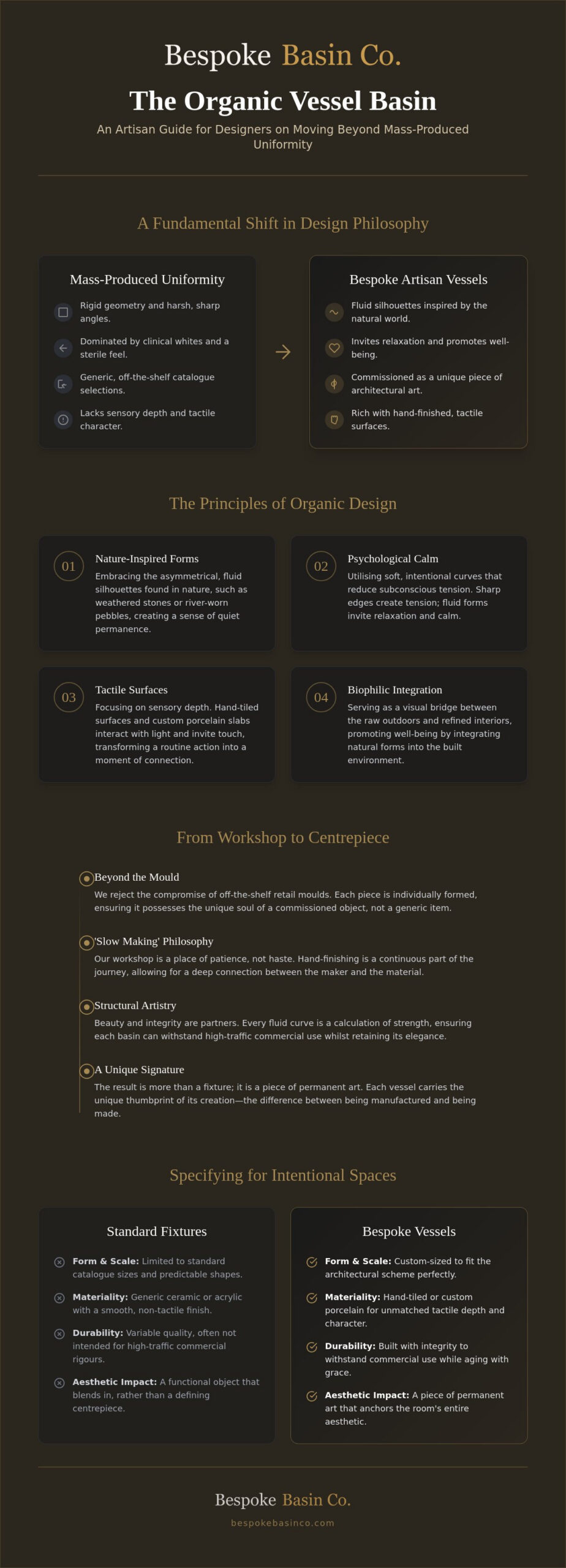
Precision is the foundation of luxury. When specifying bespoke basins for commercial interiors, the designer must look beyond the object itself. The basin exists in a dialogue with the vanity unit and the surrounding architecture. Scale is paramount. An organic vessel requires breathing room. If the footprint is too constricted, the fluid form loses its impact. If it is too small, it appears adrift on the surface. Finding this equilibrium is the first step in creating a space that feels resolved.
Tap placement is a technical decision with aesthetic consequences. Because organic forms often feature varying rim heights and asymmetrical slopes, the trajectory of the water must be carefully mapped. The flow should complement the curve, not fight it. This prevents splashing whilst maintaining the sense of calm that biophilic design promises. Weight is another practical reality. High-quality porcelain vessels possess a significant mass. For wall-hung vanity units, structural reinforcement is often necessary. This is especially true in commercial settings where durability and safety are non-negotiable requirements.
The Commissioning Process. Translating Vision.
A successful project begins with a shared vision. Our initial consultation focuses on translating your aesthetic goals into a technical reality. We discuss slab thickness, tile patterns, and installation requirements to ensure the final object fits perfectly within your scheme. For a step-by-step breakdown of this journey, read our architect’s guide to commissioning. Quality takes time. The timeline of slow production reflects our commitment to integrity. We don’t rush. We refine.
Pairing with Vanity Units. A Study in Contrast.
Contrast creates interest. Placing a soft, organic vessel on a travertine vanity unit UK establishes a sophisticated tension between materials. The rigid, linear nature of the furniture anchors the fluid shape of the basin. For a more unified look, custom-sized porcelain slabs can be specified to create a seamless transition between the horizontal surface and the vessel. This level of customisation ensures that the sanitaryware feels like an integrated part of the architectural scheme rather than an afterthought. It is about creating a sense of permanence amongst the transience of modern design.
To begin your project, we invite you to discuss your bespoke commission with our workshop team. We provide the technical support needed to bring complex, organic forms to life.
The Workshop Philosophy. Commissioning Permanent Art.
Integrity is not a concept. It is a physical reality born in the workshop. At Bespoke Basin Co., we believe that the maker must remain connected to the material from the first sketch to the final seal. This is why in-house production is non-negotiable. When you specify bespoke basins for commercial interiors, you are not just buying a product. You are entering into a partnership with a studio that values substance over speed. We reject the common industry practice of subcontracting labour. It dilutes the vision. It compromises the quality. We don’t rush the process. By maintaining a direct relationship between the client and the artisan, we ensure that every object is a precise reflection of the project’s intent. There is no middleman to misinterpret a technical requirement. There is only the maker and the designer, working together to create something permanent.
A Commitment to Manual Action
The workshop is a place of raw honesty. There is a specific pride that comes from manual labour. It is a dedication to the slow making process that defines our entire output. Hand-crafted objects carry an emotional weight that factory-made items simply cannot possess. You can feel the intention in the curve of a hand-tiled vessel. You can see the patience in the alignment of every individual tile. Mastering the craft of bespoke tiling takes years of focused practice. It is not something that can be automated or rushed. Every strike of the tool and every placement of a porcelain slab is a deliberate act of creation. This manual involvement ensures that no two pieces are ever identical. Each one possesses its own character.
The Future of Bespoke Interiors
The UK design landscape is shifting toward a more considered aesthetic. There is a growing fatigue amongst designers and developers regarding generic, mass-produced fixtures. They are looking for permanence. They want objects that offer longevity and timeless appeal. In the context of bespoke basins for commercial interiors, this means choosing materials like porcelain and travertine that age with grace. Investing in artisan-made pieces is a commitment to quality that outlasts fleeting trends. A bespoke basin is more than a functional sanitaryware item. It is a piece of permanent art. It is a legacy of craft that will occupy its space with a quiet, authoritative presence for decades. In a world of the temporary, we choose the enduring.
The Permanence of Form. A Legacy of Craft.
Organic vessel basins represent a sensory return to the natural world. They offer a departure from the clinical rigidity of mass production, favouring instead the quiet permanence of hand-worked materials. By understanding the interplay of light and texture, designers can transform a utilitarian space into a sanctuary of ritual and cleansing. These objects don’t just occupy space; they define it.
Choosing bespoke basins for commercial interiors is a commitment to the integrity of the maker. At Bespoke Basin Co., every object is hand-crafted in our UK workshop with no subcontracted labour. We maintain a meticulous attention to tactile detail to ensure each vessel carries the weight of its creation. It’s a legacy of craft that ages gracefully within a custom architectural scheme, proving that true luxury lies in the honesty of the process.
Commission your unique organic vessel basin today. Let’s work together to anchor your vision with an object that’s designed to endure.
Frequently Asked Questions
What makes a basin ‘organic’ in design?
An organic basin is defined by asymmetrical silhouettes and fluid lines that mimic the natural world. Unlike standard geometric forms, these vessels possess a softer, undulating profile inspired by weathered stones or riverbed curves. This intentional departure from rigid symmetry creates a sense of calm and permanence in high-end interiors. It’s an interpretation of nature rather than a mechanical calculation.
Are hand-tiled organic vessel basins durable enough for daily use?
Hand-tiled organic vessel basins are exceptionally durable and built for the rigours of daily use. We utilise high-fired porcelain and specialist, water-resistant grouts that ensure structural integrity over time. This makes them a reliable choice for bespoke basins for commercial interiors where longevity is as important as the aesthetic. The surface is designed to withstand high-traffic environments whilst maintaining its tactile depth.
Can I specify a custom size for my organic vessel basin?
Every commission is tailored to the specific architectural requirements of your project. We specialise in custom-sized porcelain slabs, allowing us to adjust the scale and proportions of a vessel to fit your vanity footprint perfectly. This bespoke approach ensures the basin anchors the room without overwhelming the surrounding furniture. It’s a process of translating your vision into a technical, physical reality.
How do I maintain the surface of a bespoke porcelain basin?
Maintaining a bespoke porcelain basin is a straightforward process that requires non-abrasive, pH-neutral cleaners. Porcelain is naturally resistant to staining and moisture absorption, so it doesn’t require the intensive sealing associated with softer natural stones. Regular cleaning with a soft cloth will preserve the tactile depth and finish of the surface for decades. It’s a material chosen for its quiet permanence.
Is professional installation included with a bespoke basin commission?
We provide professional in-house installation as part of our dedicated commissioning service. By avoiding subcontracted labour, we maintain total control over the integrity of the final fit. Our team ensures that the basin is perfectly aligned and secured within your architectural scheme, respecting the nuances of the custom design. This hands-on approach guarantees that the object is installed exactly as intended by the maker.
What is the typical lead time for a hand-crafted vessel basin in the UK?
The typical lead time for a hand-crafted vessel basin in the UK is between 7 and 12 days for production and delivery. This duration reflects our workshop’s “slow making” philosophy and the time required for hand-finishing each object. We prioritise precision over speed to ensure every commissioned piece meets our uncompromising standards. We don’t rush the process; we refine the object until it’s ready.
Do organic basins work with standard UK plumbing and taps?
Organic basins are designed to integrate seamlessly with standard UK plumbing and waste fittings. However, the asymmetrical rim of an organic vessel requires careful consideration of tap placement. We provide technical guidance during the design phase to ensure the water flow complements the fluid form without causing splashing. It’s about ensuring the functional flow of water matches the aesthetic flow of the basin.
Can I choose the specific tiles or porcelain slabs for my basin?
You have full creative control over the materials used in your commission. We encourage a direct relationship between the client and the workshop, allowing you to select specific porcelain slabs or tiles that align with your vision. This ensures that the final bespoke basins for commercial interiors are a unique reflection of the wider project intent. Every detail is chosen with intention to create a one-of-a-kind object.