
A luxury bathroom is not defined by the cost of the stone. It is defined by the integrity of the join. Many homeowners invest in premium materials only to find the final result feels fragmented. Visible grout lines disrupt the flow of large-format designs. Mass-produced basins often feel thin and insubstantial against heavy masonry walls. Architectural tiling for luxury bathrooms is the solution to this aesthetic friction. It is a process of deliberate, slow fabrication.
We understand that a sanctuary should feel permanent and unified. This guide shows you how bespoke surfaces and hand-tiled vessels transform a room into a seamless, hand-crafted sanctuary. You will learn the value of artisan craftsmanship in creating focal points that add genuine value to a property. We explore the technical precision required for large-format porcelain and the sensory appeal of organic textures. Form meets function. Art meets utility. The result is a space where the raw honesty of manual labour creates a finished, physical masterpiece.
Key Takeaways
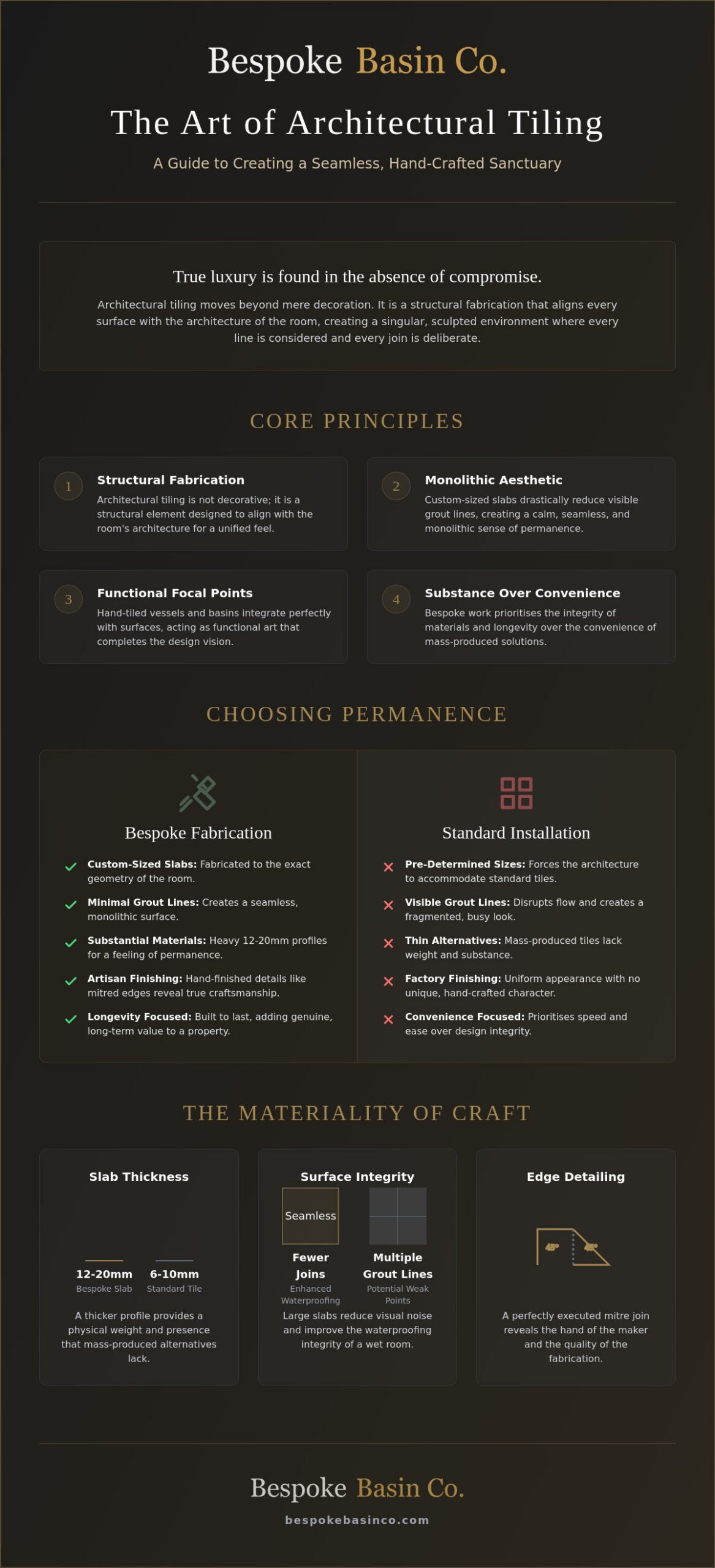
- Architectural tiling for luxury bathrooms is a structural fabrication. It moves beyond decoration to align the surface with the architecture of the room.
- Custom-sized porcelain slabs offer a monolithic aesthetic. Bespoke fabrication reduces visible grout lines to create a sense of permanence.
- Hand-tiled vessels act as functional focal points. These pieces ensure your sanitaryware integrates perfectly with the surrounding surfaces.
- Off-the-shelf retail solutions often compromise the integrity of a design. Bespoke work prioritises substance and longevity over mass-produced convenience.
- The studio approach ensures a seamless journey from concept to installation. Collaboration with an artisan maker results in a unique, hand-finished sanctuary.
Defining Architectural Tiling for Luxury Bathrooms. A Study in Precision.
Luxury is often mistaken for a specific aesthetic or a high price tag. In reality, true luxury is found in the absence of compromise. Architectural tiling for luxury bathrooms represents the intentional alignment of surface, form, and function within a living space. It is the bridge between the structural shell of a building and the intimate experience of its inhabitants. This approach treats the bathroom not as a collection of fixtures, but as a singular, sculpted environment where every line is considered. Every join is deliberate.
Standard retail tiling prioritises speed and convenience. It relies on pre-determined sizes that rarely account for the unique geometry of a room. Architectural tiling rejects this. It requires a studio approach where surfaces are fabricated to fit the architecture, rather than forcing the architecture to accommodate the tile. This precision ensures that joints are purposeful and grout lines are minimised. The result is a monolithic, calm atmosphere that feels inevitable rather than assembled. It is the hallmark of a home built with patience.
Beyond the Box. The Artisan Difference.
The role of the master artisan is to look beyond the surface of a material. It involves a deep understanding of how light interacts with texture and how a hand-cut edge feels compared to a factory finish. Whilst the history of decorative tilework shows us that tiles have always been used to beautify, modern architectural methods elevate this to a structural level. We reject mass-produced uniformity. We prefer organic, unique textures that tell a story of origin and craft. Architectural tiling is a bespoke fabrication process rather than a retail installation. This distinction is vital. It moves the project from a simple trade to a dedicated work of artistry.
The Permanence of Luxury. Why Materials Matter.
High-end UK bathroom design is moving away from fleeting trends. There is a renewed focus on materials that offer longevity and a sense of permanence. Porcelain and natural stone, when integrated correctly into the architecture through bespoke tiling for interiors, create a sanctuary that resists the passage of time. It isn’t about what’s “in” this season. It’s about the raw honesty of the material and the integrity of the installation. A hand-finished surface doesn’t just look better; it feels grounded. It provides a tactile connection to the home that mass-produced alternatives cannot replicate. This commitment to substance is what adds lasting value to a property.
The Materiality of Custom Porcelain Slabs and Artisan Surfaces.
Architectural tiling for luxury bathrooms begins with the selection of the substrate. It is a choice between the temporary and the permanent. Modern design has moved beyond the constraints of standard tile sizes, embracing custom-sized porcelain slabs that allow for a truly monolithic aesthetic. These large-format surfaces reduce the visual noise of grout lines, creating a sense of calm that is essential for a sanctuary. When a surface is fabricated to the exact dimensions of a wall or floor, the architecture itself becomes the ornament.
The quality of the finish is defined by the details that often go unnoticed. Slab thickness is a primary consideration. A 12mm or 20mm porcelain profile provides a physical weight and presence that thinner, retail-grade alternatives lack. Edge detailing, such as a perfectly executed mitre or a hand-finished bullnose, reveals the hand of the maker. These subtle choices ensure the material occupies the space with authority. Viewing our portfolio of bespoke tiling projects reveals the difference that custom fabrication makes to the final atmosphere of a room.
Custom-Sized Porcelain Slabs. Engineering Elegance.
Made-to-measure porcelain is more than an aesthetic preference; it is a technical necessity for high-performance wet rooms. Large slabs mean fewer joints, which naturally enhances the waterproofing integrity of the environment. Sourcing the correct dimensions allows for seamless transitions from floor to ceiling, eliminating the awkward “off-cuts” common in standard installations. For those seeking visual balance, our guide on bookmatched porcelain slabs UK details the precision required to achieve perfect symmetry across a custom surface.
Texture and Tone. The Sensory Bathroom.
A successful design balances the cool, engineered precision of porcelain with the warmth of natural materials. Integrating a Travertine Vanity Unit provides a textural counterpoint to the smooth expanse of a porcelain wall. The interplay between these surfaces is where the sensory experience lives. Light plays a vital role here. It catches the soft pits of the stone and the subtle grain of the porcelain, highlighting the depth of the work. The nuances of artisan tile design and installation often dictate how these materials interact with the shifting light of the day. By pairing an Organic Vessel Basin with a muted, earthy colour palette, the space feels grounded and intentional. It is a narrative of patience. It is the result of slow production and careful thought.
Bespoke Fabrication vs. Standard Retail Solutions. Choosing Permanence.
Standard retail solutions operate on a logic of volume. They prioritise the movement of boxes over the integrity of the finished space. When you choose off-the-shelf basins or standard tile sizes, you’re forced to accept the limitations of the factory. These fixed dimensions often lead to awkward cuts, mismatched patterns, and a fragmented aesthetic. Architectural tiling for luxury bathrooms requires a departure from this retail mindset. It demands a move toward bespoke fabrication where the material is shaped to the specific requirements of the architecture.
The term “affordable luxury” is frequently used to mask compromises. In the context of tiling, this often means thinner porcelain, less precise edge finishing, or a reliance on grout to hide poor alignment. These shortcuts undermine the sense of calm that a high-end bathroom should provide. A truly unique interior space is built on a foundation of substance. It requires an artisan studio approach where every slab is hand-selected and every joint is engineered for permanence. This commitment to quality ensures that the installation remains as striking in a decade as it is on the day of completion.
The Pitfalls of Subcontracted Labour.
High-end architectural tiling is a specialist discipline. It isn’t a task that can be passed to general tradespeople without risking the final vision. The disconnect between the design workshop and the building site is where many luxury projects fail. We’ve found that a dedicated, in-house team is non-negotiable. Continuity is essential. At the Bespoke Basin Co. studio, we manage the entire process from the initial concept to the final, hand-finished installation. This avoids the “retail gap” and ensures that the precision of the workshop is mirrored in the bathroom itself. It’s about personal accountability and a shared pride in the output.
The Investment of Bespoke. Justifying the Craft.
Slow production has a cost. Manual labour and the careful handling of large-format slabs require time and expertise that mass-market providers simply don’t offer. However, this investment translates directly into the long-term value of a residential project. Bespoke basins and custom-fabricated surfaces act as functional art. They’re focal points that distinguish a property in a crowded market. Bespoke work is a hedge against the transience of modern retail trends. By choosing craftsmanship over convenience, you’re investing in a timeless sanctuary that prioritises depth, texture, and the raw honesty of natural materials. Quality is a quiet statement that doesn’t need to shout.
Integrating Hand-Tiled Vessels and Seamless Wet Room Environments.
The transition from a wall surface to a functional fixture is where many designs falter. In a standard installation, the basin is an afterthought. It’s a ceramic object bolted to a tiled wall. Architectural tiling for luxury bathrooms seeks a different result. It aims for a monolithic flow where the basin is an extension of the room’s skin. By using the same material for the walls, floors, and sanitaryware, we create a visual continuity that expands the sense of space. It is a quiet, powerful cohesion.
Achieving this “organic” feel requires more than just matching colours. It involves the soft-edge fabrication of porcelain and the careful hand-finishing of every exposed corner. When the eye isn’t interrupted by a change in material or a clumsy joint, the mind finds rest. This is the essence of a sanctuary. Each hand-tiled vessel basin we produce serves as the functional focal point, grounding the room in a narrative of intentional craft and permanence. You can explore our collection of bespoke tiled basins to see how these elements unite.
The Art of the Hand-Tiled Vessel.
Standard ceramics are limited by the kiln and the mould. They favour uniformity over character. Hand-tiling allows for complex, organic shapes that mass-production cannot replicate. The process is meticulous. It requires the precise alignment of individual tiles over curved surfaces, ensuring the pattern remains unbroken and the tactile quality is preserved. In the art of the hand tiled vessel basin, we explore how texture and form interact to create something truly unique. It is a study in patience. Every tile is placed with the final user’s touch in mind.
Seamless Wet Rooms. Crafting Sanctuaries.
A wet room is a technical challenge disguised as a minimal space. The beauty of a seamless floor is only possible through rigorous subsurface engineering. Integrating drainage and plumbing into custom porcelain slab designs requires a workshop-level of precision. Whether for residential use or the higher demands of bespoke wet room tiling in commercial settings, waterproof integrity is the primary concern. We don’t rely on generic kits. Instead, we fabricate the drainage slopes and slab joins to ensure a permanent, leak-proof environment. For a deeper understanding of how bespoke porcelain surfaces are specified and installed in these demanding environments, our guide to custom tiling for wet rooms explores the full technical and aesthetic process. The result is a space that feels effortless whilst being built to endure for decades. Quality is found in what is hidden as much as what is seen.
Commissioning Excellence. The Bespoke Basin Co. Studio Approach.
The journey from an initial concept to a hand-finished installation is a deliberate one. It requires a partnership between the designer and the maker. Architectural tiling for luxury bathrooms is not a transaction. It is a commission. We move beyond the limitations of retail by treating the entire room as a single, fabricated object. This ensures that the architectural intent is never lost in the transition from paper to porcelain. The result is a space that feels inevitable. It feels grounded.
In high-end residential and commercial developments, the value of a project is found in its unique details. Custom commissions allow for a level of coordination between surfaces and sanitaryware that mass-produced items cannot replicate. It is a narrative of patience. We focus on the raw honesty of the work, ensuring that every slab and vessel basin contributes to a sense of permanence. This is the intersection of craft, surface, and architectural intent. It is where the workshop meets the sanctuary.
The Commissioning Process. A Thoughtful Guide.
Collaboration begins with a quiet, intentional consultation. We discuss the physical state of the materials, the scale of the room, and your tactile requirements. This isn’t about picking a product from a catalogue. It’s about understanding how the surface will occupy the space. During the design phase, we plan the layout of custom-sized porcelain slabs with mathematical precision. We account for every joint and mitre. Because this is slow-made work, lead times reflect the manual action and personal involvement required for each piece. Quality requires time. It demands focus.
Your Permanent Sanctuary. Next Steps.
Choosing an artisan tiling studio UK is a commitment to the integrity of your home. It’s a rejection of the “cheap” feel of mass production in favour of substance and longevity. We act as a trusted partner for those who appreciate the nuances of custom work and the value of slow production. To begin your bespoke basin or architectural tiling project, we invite you to reach out to our studio to discuss your vision. Explore our collection of bespoke tiled basins to see the standard of craftsmanship we bring to every project. Your sanctuary starts here.
Crafting Permanence. Your Architectural Sanctuary.
The transition from a mere room to a hand-crafted sanctuary is a journey of precision. It requires a move away from the limitations of retail uniformity toward the raw honesty of manual labour. Architectural tiling for luxury bathrooms is the foundation of this shift. It ensures that every line is intentional and every surface is integrated. By choosing bespoke fabrication, you invest in a space that prioritises substance and longevity over fleeting trends. The result is a monolithic environment where form and function exist in perfect harmony.
At the Bespoke Basin Co., we specialise in custom-sized porcelain slabs and hand-tiled vessels created through in-house artisan fabrication. We don’t use subcontracted labour. This continuity of craft ensures that the integrity of your vision is maintained from the workshop to the final installation. It is a quiet commitment to quality that adds genuine value to your property. We invite you to commission your bespoke architectural bathroom sanctuary. Your vision deserves the dedication of a master maker. Let’s build something that lasts.
Frequently Asked Questions
What is the difference between architectural tiling and standard bathroom tiling?
Architectural tiling is a structural fabrication process. Standard tiling involves applying pre-cut, factory-uniform tiles to a surface. In architectural tiling for luxury bathrooms, every slab is hand-selected and cut to fit the specific geometry of the room. This approach eliminates awkward off-cuts and ensures that grout lines are purposeful. It moves the project from a simple trade to a bespoke service where the surface aligns perfectly with the architecture.
Can custom-sized porcelain slabs be used in a small luxury bathroom?
Custom-sized porcelain slabs are highly effective in smaller spaces. By reducing the number of grout lines, you create a monolithic surface that expands the visual perception of the room. Large-format slabs eliminate the cluttered “grid” effect common with smaller tiles. This technique prioritises a calm, unified aesthetic. It allows a compact bathroom to feel like a spacious sanctuary through the use of continuous, unbroken textures.
Are hand-tiled vessel basins as durable as traditional ceramic sinks?
Hand-tiled vessels are exceptionally durable and often surpass traditional ceramics in performance. We use high-performance porcelain, which is denser and less porous than standard ceramic. This makes the surface highly resistant to staining, scratching, and thermal shock. The structural integrity is ensured through expert fabrication in our workshop. These pieces are engineered to endure daily use whilst maintaining their tactile beauty for decades.
How do I specify bespoke tiling for a wet room project?
Specifying bespoke tiling for a wet room requires a focus on drainage integration and subsurface engineering. You should define the fall of the floor to ensure efficient water movement. In architectural tiling for luxury bathrooms, we fabricate porcelain slabs to accommodate your specific plumbing layout. This ensures a seamless transition from the dry area to the shower zone without the need for unsightly plastic trim or mismatched joints. Our dedicated guide to custom tiling for wet rooms provides a detailed overview of the specification process for bespoke porcelain surfaces.
Why should I choose an artisan studio over a luxury tile retailer?
An artisan studio offers personal accountability and bespoke fabrication that a retailer cannot provide. Retailers sell mass-produced products in boxes. They don’t account for the unique geometry of your project. A studio manages the entire journey from material selection to the final installation. This ensures continuity and precision. You aren’t just buying a material; you’re commissioning a master maker to integrate that material into your home’s architecture.
What materials are best for a bespoke vanity unit in a high-humidity environment?
Porcelain and natural stones like travertine are ideal for high-humidity environments. These materials are naturally resistant to moisture and won’t warp or degrade like timber-based alternatives. A Travertine Vanity Unit provides a grounded, organic texture that thrives in a wet room setting. When paired with custom porcelain slabs, these materials create a permanent sanctuary that resists the passage of time and the effects of steam.
How do custom porcelain slabs improve the maintenance of a luxury bathroom?
Custom porcelain slabs significantly improve maintenance by reducing the total area of grout. Grout is the most vulnerable part of any tiled surface. It is prone to discolouration and mould over time. By using large-format slabs, you eliminate the majority of these joints. The resulting surface is non-porous and easy to wipe clean. It ensures your sanctuary remains pristine with minimal effort, preserving the integrity of the design for years.
What is the lead time for a custom hand-tiled basin commission?
Lead times for a custom hand-tiled basin typically range from six to ten weeks. This reflects the “slow making” philosophy of our studio. Every commission involves a meticulous process of material selection, precision cutting, and hand-finishing. We don’t rush the production phase. The time taken ensures that every joint is perfect and every surface is tactile. It is a process of dedication that results in a unique, functional work of art.