
Why settle for a surface that merely covers a wall when you can command a space with a living mirror of stone? In high-end British interiors, the difference between a room and an experience often lies in the continuity of the materials. You seek a finish that feels intentional. The grain should flow without interruption, creating a rhythmic surface that breathes life into a bathroom or a grand entrance hall. Achieving this level of symmetry requires more than just an eye for design. It demands a deep, technical understanding of bookmatched porcelain slabs UK.
We understand the hesitation that comes with specifying these materials. The fear of a visible grout line breaking the illusion, or the confusion of coordinating Block A and Block B sequences, can stifle the creative process. This guide provides the technical clarity you need to specify and utilise these slabs with absolute confidence. We will walk through the nuances of bespoke sizing, the structural integrity of large-format porcelain, and the artisan approach to installation that ensures your project feels like a single, permanent work of art.
Key Takeaways
- Master the mechanics of symmetry. Learn how to specify Block A and Block B sequences to ensure your mirrored surfaces flow with an intentional, uninterrupted grain.
- Elevate functional spaces. Discover how to apply bookmatched porcelain slabs UK within wet rooms and custom basins to create a seamless, sanctuary-like environment.
- Precision in the details. Understand why 1.5mm grout lines and perfectly flat substrates are non-negotiable for maintaining the rhythmic illusion of a continuous surface.
- The artisan standard. Explore why a dedicated, in-house installation approach is essential for handling the fragility and scale of large-format porcelain slabs.
Defining Bookmatched Porcelain Slabs. The Search for Visual Continuity.
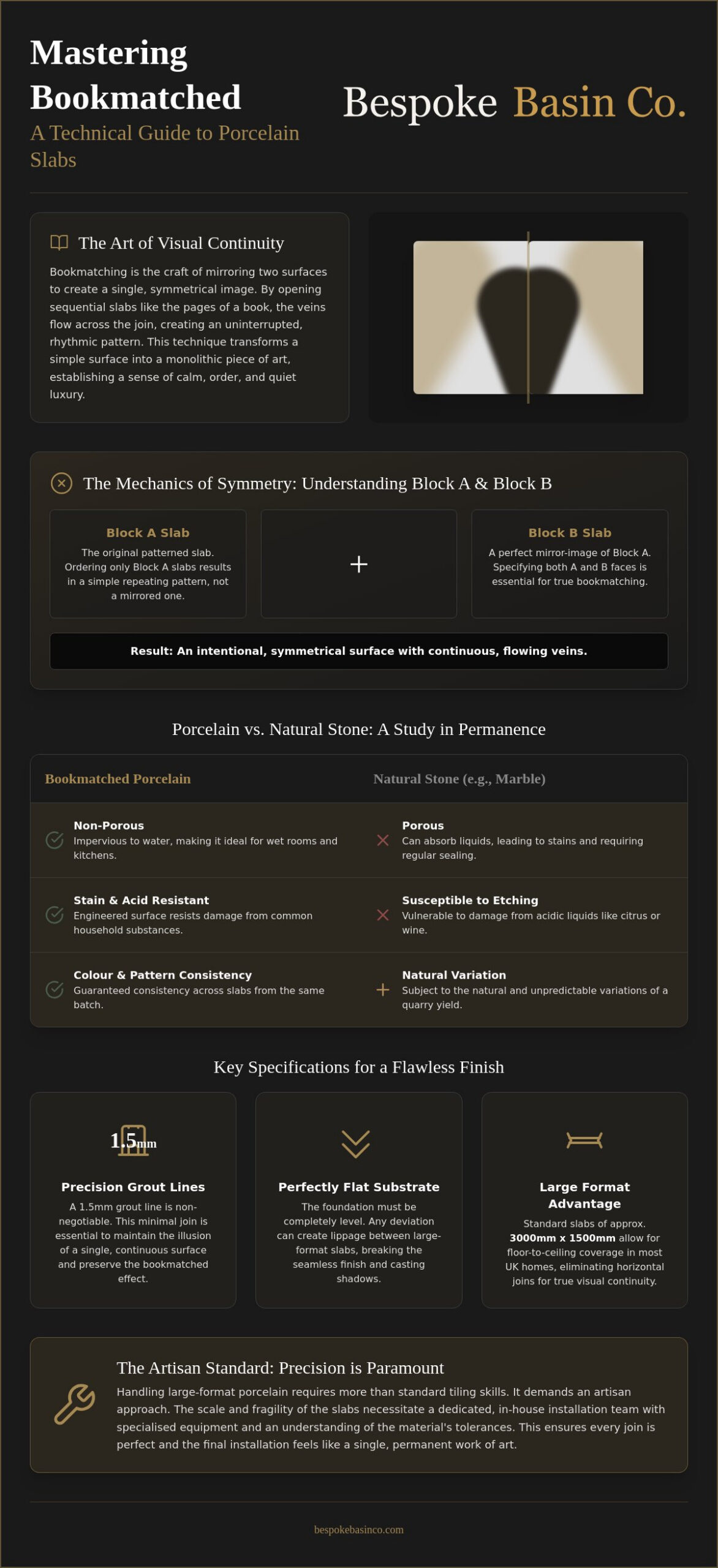
Bookmatching is an ancient craft. It is the deliberate mirroring of two or more surfaces to create a single, symmetrical image. Defining Bookmatched Porcelain Slabs requires looking back at the great marble quarries of Italy. Traditionally, a single block of stone was sliced into sequential leaves. When opened like the pages of a book, the veins create a rhythmic pattern that flows across the join. Today, modern technology allows us to replicate this with bookmatched porcelain slabs UK, offering a level of precision that nature alone cannot always guarantee. We no longer rely on the chance of a quarry’s yield. Instead, we control the rhythm of the surface.
The sensory appeal of a continuous vein is undeniable. It flows across an entire room, connecting separate architectural elements into a cohesive whole. It makes a wall feel like a singular, monolithic piece of art. This continuity is the hallmark of intentional design. It creates a narrative of permanence and quiet luxury that resonates within a space.
The Aesthetic of Mirrored Surfaces. Calm through Symmetry.
Symmetry offers a visual anchor. It creates a sense of order. In high-end residential design, this balance translates to a feeling of calm. The eye finds rest in the repetition. Classical architecture relied on these principles to convey authority and stability. Modern slabs allow you to choose between the drama of bold, sweeping veins and the quiet elegance of subtle, refined patterns. The choice depends on the narrative of the room and the desired emotional response.
Porcelain vs Natural Stone. A Study in Permanence.
Porcelain is engineered for longevity. Unlike natural marble, it is non-porous. It resists stains and acidic damage. This makes it ideal for wet rooms and kitchens where stone might fail. The structural integrity is superior. Modern manufacturing ensures the material is dense, uniform, and stable. Choosing between a Tiled vs Travertine Vanity reveals the practical benefits of porcelain. It offers a resilience that natural travertine often lacks in high-moisture environments.
The tactile experience has evolved. Many slabs now possess a honed finish that mimics the soft, cool touch of natural stone. Every installation of bookmatched porcelain slabs UK is a testament to this marriage of art and utility. It provides the visual depth of a natural material with the uncompromising performance of modern engineering.
The Mechanics of Symmetry. Understanding Block A and Block B.
Achieving a mirrored effect is a matter of technical discipline. It begins in the factory. Unlike standard tiles, bookmatched porcelain slabs UK are produced in sequential pairs. One slab is the direct reflection of the other. We refer to these as Block A and Block B. To create a true mirror, you must specify both faces. If you order only Block A, the pattern will simply repeat. It will lack the rhythmic tension that defines a bookmatched surface. The symmetry must be intentional from the moment of specification.
Batch numbers are equally critical. Porcelain is a ceramic material fired at high temperatures. Slight variations in mineral composition or kiln temperature can alter the base tone. When working with large surfaces, even a fractional shift in colour becomes visible. We ensure every slab in a project shares the same batch number. This guarantees that the background white of one slab perfectly meets the white of its partner. It ensures the surface feels like a single, uninterrupted thought.
The scale of these slabs is a functional advantage. Most large-format slabs measure approximately 3000mm x 1500mm. This size allows for floor-to-ceiling coverage in many British homes without a single horizontal join. Fewer joins mean fewer interruptions. The surface remains continuous. It feels like a single, massive block of stone has been opened and laid flat. The Artisan Approach to material selection treats these dimensions not as a challenge, but as a canvas for architectural continuity.
Sequential Fabrication Patterns. The Precision of the Join.
The mirror is achieved during the printing and vitrification process. High-definition digital heads apply the mineral patterns with absolute precision. Aligning these veins requires a tolerance of less than 1mm. This level of accuracy is what gives the installation its architectural weight. Random slabs might look pleasant, but they lack the intentionality of a choreographed mirror. Every line must find its partner at the seam.
Sizing and Scale Considerations. Beyond the Flat Surface.
Specification involves more than just floor area. You must consider the thickness. A 6mm slab is lighter and suited for wall cladding, whilst a 12mm slab offers the structural integrity needed for worktops or custom-sized porcelain slabs. Planning the flow through a three-dimensional space requires foresight. The vein must move from the floor, up the wall, and perhaps over a vanity unit without losing its rhythm. It requires a steady hand and a clear plan.
Applications in High-End UK Interiors. Beyond the Feature Wall.
High-end interiors demand more than a flat surface. They require a holistic environment where every element feels connected. Whilst many designers begin with a feature wall, the true potential of bookmatched porcelain slabs UK is found in more immersive applications. A wet room should feel like a sanctuary. By using mirrored slabs, we can create shower enclosures that appear carved from a single block of stone. This eliminates the visual clutter of multiple grout lines. It focuses the eye on the rhythm of the vein. The eye finds rest in the symmetry. It is a moment of pause in a busy world.
Achieving this “carved” aesthetic requires a technical marriage of surface and drainage. Bespoke Wet Room Tiling is as much about what is beneath the surface as what is on top. When using large-format slabs, the fall towards the drain must be handled with extreme precision. We ensure the pattern remains undisturbed even as the floor slopes. This level of detail is what separates a standard installation from an artisan commission.
Bookmatched Wet Rooms and Sanctuaries.
The goal is a seamless transition. In a wet room, the porcelain must perform under constant moisture whilst maintaining its visual integrity. We prioritise the continuity of the grain across internal corners. This creates a sense of enclosure and permanence. It feels grounded. By adhering to Technical Considerations for Designers, we ensure the substrate is perfectly prepared to support the weight and scale of these slabs, preventing any movement that could ruin the mirrored effect. For those seeking to understand the full scope of what bespoke porcelain can achieve in a moisture-rich environment, our guide to custom tiling for wet rooms explores the architectural nuances of specifying surfaces that endure the passage of time.
Integration with Bespoke Sanitaryware.
Integration is where the artisan’s touch becomes truly visible. We don’t just place a basin against a wall. We wrap the vanity unit in the same porcelain. This creates a monolithic look that feels permanent. It’s about visual continuity. The vein flows from the wall, across the countertop, and down the face of the basin. This intersection of Bespoke Tiled Basins UK and large-format backdrops is the pinnacle of custom tiling. It requires a deep understanding of mitred joins to ensure every edge is clean and every join is stable. The hand-tiled vessel becomes an extension of the wall itself. It is a slow, deliberate process that rewards patience.
Beyond the bathroom, porcelain offers unique advantages. It is thermally stable. This makes it a superior choice for feature fireplaces where natural stone might crack under intense heat. In commercial lobbies, the scale of bookmatched porcelain slabs UK provides an immediate sense of gravitas. It speaks of longevity. It suggests a business that values substance. Whether it is a grand entrance hall or a private residence, the use of mirrored surfaces elevates the architecture. It turns a functional space into a deliberate statement of craft. The surface occupies the space with a quiet, authoritative presence.
Specifying for Permanence. Technical Considerations for Designers.
The integrity of a mirrored surface begins long before the first slab is laid. It starts with the substrate. For bookmatched porcelain slabs UK, the background must be perfectly flat. We look for a tolerance of no more than 3mm over a 3-metre span. Any deviation creates a hollow point, leading to potential cracking or a visible lip at the join. This is a matter of structural permanence. We use high-performance, flexible adhesives designed specifically for large-format porcelain to ensure a complete bond. The adhesive must be applied to both the wall and the slab to eliminate air pockets.
Movement joints are a necessity. They protect the installation from the natural expansion and contraction of the building. However, they don’t have to be intrusive. We hide these joints in internal corners or use colour-matched silicones that disappear into the pattern. It is a balance of engineering and aesthetics. We prioritise the safety of the structure without compromising the visual flow of the vein.
The Precision of Grout and Alignment. The Invisible Join.
A 1.5mm grout line is our standard. It is thin enough to maintain the illusion of a single block whilst allowing for the necessary structural movement. We colour-match the grout to the slab’s base tone, ensuring the transition is felt rather than seen. Levelling systems are non-negotiable. We use clips and wedges to pull the slabs into a perfectly flush plane. Sometimes, the printing process results in a slight drift in the vein. The artisan’s eye corrects this on-site, manually adjusting the alignment to ensure the rhythm of the stone remains true. Understanding the full scope of architectural tiling for luxury bathrooms reveals why this level of precision is what separates a bespoke commission from a standard installation.
Handling and Logistics on Site. The Weight of Craft.
A 3-metre slab is both massive and fragile. Moving these pieces through narrow UK residential corridors requires more than just strength. It requires specialised suction frames that distribute the weight evenly. Without these, the slab can flex and snap under its own mass. Standard tilers often struggle with this scale. The equipment is heavy. The stakes are high. Every cut is a commitment. We handle every slab with a level of care that reflects its value. If you are planning a project that requires this level of technical dedication, you can commission our team for Bespoke Tiling services.
The Artisan Approach. Precision Installation and Custom Commissions.
A surface is only as good as the hands that place it. For bookmatched porcelain slabs UK, this belief is absolute. We reject the common practice of subcontracting installation to general tradespeople. A mirrored surface is a delicate choreography of grain and join. It requires a level of patience that is often absent in high-speed construction. Every cut is a commitment to the final image. By keeping every aspect of the fabrication and installation within our own studio, we maintain total control over the narrative of the work. The result is a surface that flows with an intentional, quiet confidence.
Our workshop philosophy extends beyond the wall. We often create a tactile dialogue by combining custom-sized porcelain slabs with our hand-tiled vessels or an organic vessel basin. This creates a unified sensory experience. The expansive vein of the porcelain provides the backdrop, whilst the texture of the basin provides the focal point. It is a journey from an architectural specification to a physical, permanent reality. We do not rush the process. We prioritise depth over speed, ensuring that the integrity of the material is respected at every stage.
In-House Mastery vs Subcontracting. Total Accountability.
Subcontracting introduces unnecessary risk. A general contractor may understand the mechanics of tiling, but they rarely grasp the architectural weight of a bookmatched sequence. We act as a single point of accountability. From the first drawing to the final grout line, the responsibility rests with us. This ensures that the original vision of the designer is never diluted by a lack of technical understanding. Our Artisan Tiling Studio UK is built on this foundation of uncompromising standards. We are guardians of the final result.
Commissioning Your Bespoke Surface. A Collaborative Journey.
The process of commissioning bookmatched porcelain slabs UK is deeply collaborative. We work closely with interior designers to tailor slab layouts to the specific dimensions of a room. We look for the natural focal points. We consider how light interacts with the polished or honed surface at different times of day. This is not a retail transaction. It is a bespoke commission. By using artisan techniques, such as hand-mitred edges and precise vein-matching, we ensure the longevity of the installation. We create spaces that feel grounded, permanent, and entirely unique to the client.
The Permanence of Mirrored Design. A Future of Symmetry.
Achieving a truly mirrored surface is a technical discipline that rewards patience. It requires a clear understanding of sequential fabrication and the uncompromising precision of an artisan. By prioritising substrate stability and the subtle alignment of Block A and Block B sequences, you ensure your interior feels like a single, intentional piece of stone. This is not a surface that merely occupies a room. It is a surface that defines it. When specifying bookmatched porcelain slabs UK, the difference between a standard finish and an architectural statement lies in the details of the join.
Your project deserves a partner who values longevity as much as you do. If you are ready to elevate your space with this level of craft, you can commission your bespoke porcelain surface from our artisan studio. Our in-house expert installation team brings a workshop philosophy to every project. We are specialists in bespoke tiled basins and custom slabs, maintaining uncompromising artisan standards from the first cut to the final seal. Let us help you create a space that feels grounded, permanent, and entirely yours.
Frequently Asked Questions
What is the difference between Block A and Block B in bookmatched slabs?
Block A and Block B represent the two sequential faces of a mirrored pattern. In the production of bookmatched porcelain slabs UK, these are printed as direct reflections of one another. To achieve a true symmetrical effect, you must specify one of each. If you use two Block A slabs, the pattern will simply repeat rather than mirroring at the join.
Can bookmatched porcelain slabs be used for underfloor heating systems?
Yes, porcelain is an exceptional conductor of heat and is entirely compatible with underfloor heating. Its mineral composition ensures thermal stability, meaning it won’t warp or crack during temperature fluctuations. We recommend using a high-quality flexible adhesive and maintaining a 1.5mm grout line to accommodate the subtle expansion and contraction of the substrate.
How do you hide the grout lines in a bookmatched porcelain installation?
We minimise the visibility of joins by using ultra-fine 1.5mm spacers and colour-matching the grout to the slab’s base tone. This ensures the eye follows the vein rather than the break. Using a high-precision levelling system is also essential. It pulls the slabs into a perfectly flush plane, eliminating shadows that would otherwise reveal the location of the join.
Are bookmatched porcelain slabs suitable for high-traffic commercial areas?
Porcelain is significantly harder and more scratch-resistant than most natural stones, making it ideal for commercial lobbies and entrances. It is a non-porous material that resists staining and moisture absorption. This durability ensures that even in areas with heavy footfall, the mirrored pattern remains clear and the surface maintains its structural integrity over time.
What is the standard thickness for bookmatched porcelain slabs in the UK?
In the UK market, the standard thicknesses are typically 6mm and 12mm. We generally specify 6mm slabs for wall cladding and feature walls because they are lighter and easier to handle on vertical surfaces. The 12mm thickness is the preferred choice for flooring, worktops, and custom furniture where greater structural rigidity is required.
How do I clean and maintain a bookmatched porcelain feature wall?
Maintenance is simple because the surface is non-porous and does not require sealing. You should use a pH-neutral cleaner and a soft microfibre cloth to remove dust or surface marks. Avoid using abrasive pads or harsh acidic chemicals, as these can eventually dull the finish. Regular, gentle cleaning is all that is needed to preserve the clarity of the pattern.
Can I use bookmatched slabs for a bespoke bathroom vanity unit?
Yes, wrapping a vanity unit in bookmatched porcelain is a hallmark of high-end artisan design. It creates a monolithic appearance where the vein flows seamlessly from the wall, across the countertop, and down the face of the unit. This application requires expert mitring and a steady hand to ensure the joins are clean and the symmetry is maintained.
Is it possible to bookmatch more than two slabs for a larger wall?
It is entirely possible to create a “quad-match” or an extended sequence for larger architectural surfaces. This process involves using multiple pairs of Block A and Block B slabs in a specific, choreographed order. Achieving this requires a detailed cutting plan and a deep understanding of the pattern’s rhythm to ensure the veins align across every horizontal and vertical seam.