
A hotel basin is not a mere plumbing fixture; it is a permanent architectural surface that defines the guest’s sensory experience. In a world of mass production, the quiet weight of a handcrafted object offers a sense of permanence that generic alternatives cannot replicate. You likely recognise the frustration of specifying bespoke basins for hotels UK only to find makers who cannot bridge the gap between artisan fabrication and commercial installation. There is often a lingering concern regarding grout integrity and the long-term maintenance of wet rooms in high-traffic settings.
This article provides an architectural exploration of unique tiled sanitaryware, moving beyond surface aesthetics to the technical rigour required for hospitality. We will examine why high-performance porcelain is the definitive choice for commercial longevity and how a dedicated maker ensures structural integrity in line with current UK Building Regulations. You will gain a clear framework for the commissioning process, ensuring your next project benefits from the raw honesty of manual labour and the precision of modern engineering. From structural build to the sensory impact of tactile surfaces, we outline how to elevate a utility into a sculptural centrepiece.
Key Takeaways
- Understand the transition from mass-produced fixtures to intentional architectural features that prioritise sensory connection and permanence.
- Identify why specifying bespoke basins for hotels UK requires high-performance porcelain to withstand the rigours of commercial cleaning and heavy use.
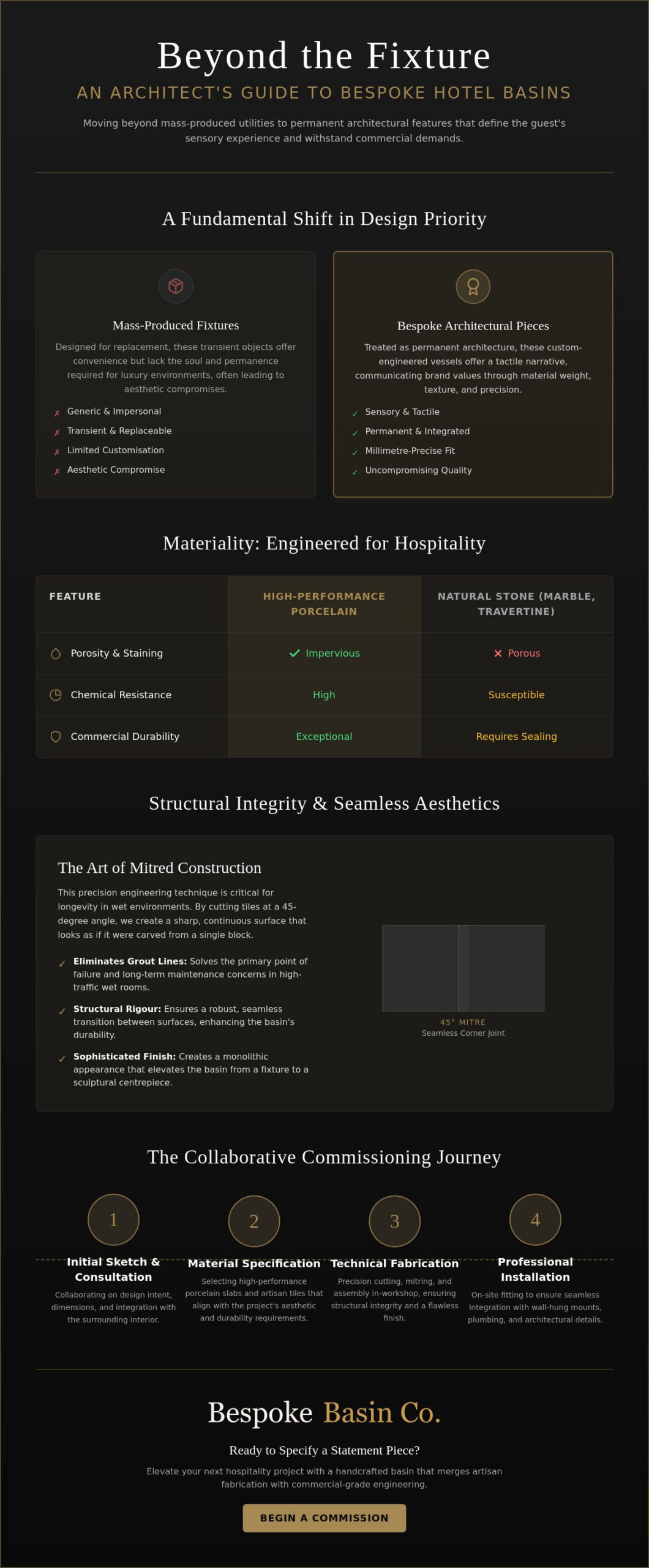
- Master the technical nuances of mitred construction, a process that ensures seamless transitions and solves the issue of grout longevity in wet environments.
- Learn to integrate floating wall-hung mounts and shadow gaps to create a sophisticated aesthetic that complements natural stone and high-end interiors.
- Navigate the collaborative commissioning process from initial sketch to final installation, ensuring a seamless journey for complex hospitality projects.
The Shift Towards Bespoke Basins for Hotels in the UK
In the context of British hospitality, bespoke basins for hotels UK are no longer viewed as simple utilities. They are custom-engineered vessels, meticulously finished with hand-applied porcelain or ceramic tiles. This represents a fundamental shift in design priority. For decades, the history of sanitaryware was defined by mass-produced white ceramic. These items were functional but lacked soul. Today, architects and developers are moving toward intentional, sensory features that anchor a room. Unique tiled sanitaryware UK serves as a quiet, authoritative focal point for boutique branding. It tells a story of attention to detail.
The “slow making” philosophy stands as a necessary counterpoint to the rush of commercial construction. It is a commitment to depth. It is a refusal to cut corners. By treating the basin as a piece of permanent architecture, the hotel creates a focal point that communicates its brand values through material weight and texture. This approach prioritises the integrity of natural materials over the convenience of the assembly line. It is a narrative of patience. Each tile is laid with a specific intent, ensuring that the final object possesses a sense of groundedness and calm.
The Guest Experience. A Tactile Narrative.
The basin is likely the most-touched surface in a hotel suite. It’s the first point of contact in the morning and the last at night. When a guest feels the cool, precise edge of a hand-tiled vessel, they feel the care invested in the space. Natural textures and artisan craftsmanship create an emotional resonance that mass-market fixtures cannot achieve. It’s about the physical sensation of quality. This tactile narrative bridges the gap between the intimate comfort of domestic life and the sophisticated opulence of a luxury hotel. Guest satisfaction is often found in these quiet, physical details that suggest a space was built to last.
Architectural Permanence. Retail Convenience.
Retail units are designed for replacement. They are transient objects made for a broad market. In contrast, bespoke basins for hotels UK are designed for permanence. They allow for seamless integration with specific room layouts, fitting into narrow alcoves or spanning wall-to-wall with millimetre precision. This level of customisation ensures that the sanitaryware feels like an organic part of the building’s fabric rather than an afterthought. You can explore the broader context of this shift in our study on the evolution of bespoke interior basin design. Selecting permanent fixtures over replaceable units is a declaration of quality. It’s an investment in the building’s future. It eliminates the aesthetic compromise often found in off-the-shelf solutions.
Materiality and the Craft of Unique Tiled Sanitaryware
The foundation of bespoke basins for hotels UK begins with the selection of custom-sized porcelain slabs. These slabs are not merely surfaces; they are the structural core of the vessel. In high-traffic hospitality environments, the preference for porcelain over natural stone is a matter of practical rigour. While marble and travertine offer undeniable beauty, they are porous and susceptible to staining from oils, perfumes, or acidic soaps. Porcelain provides an impervious alternative. It resists the aggressive commercial cleaning agents required in a professional setting while maintaining the aesthetic depth of a handcrafted object. It is a balance of art and utility.
Selection of the outer tile layer is equally deliberate. Artisan tiles are chosen for their non-porosity and their ability to meet British Standards for tiling. This ensures that the installation remains hygienic and structurally sound over decades of use. The modern British hotel interior currently favours a palette rooted in the landscape. We see a move toward clay, sand, and sage. These earthy tones provide a sense of grounded luxury that feels timeless rather than trendy. It is a visual language that prioritises the integrity of the material itself. It feels intentional.
The Performance of Custom Porcelain Slabs
Porcelain is the superior choice for hospitality due to its remarkable resistance to thermal shock and chemical abrasion. When engineering made-to-measure slabs, the goal is to create monolithic forms that appear carved from a single block. This precision allows for the creation of seamless internal slopes that ensure efficient drainage. Durability benchmarks in luxury wet rooms demand materials that do not degrade under constant moisture. Porcelain slabs meet these requirements with ease. They provide a stable, rigid substrate that prevents the micro-movements that often lead to grout failure in lesser installations.
Artisan Tiling: Texture as a Design Tool
Texture serves as a primary design tool in the contemporary hotel bathroom. The interplay of light on a matte surface creates a soft, diffused glow, while high-gloss hand-tiled surfaces offer a more traditional, reflective elegance. For projects seeking a softer silhouette, an Organic Vessel Basin provides a sculptural alternative to geometric slabs. These curved forms introduce a sense of movement into the room. Bespoke tiling allows architects to create a cohesive visual narrative, linking the basin to the surrounding walls or floors. This continuity of material is what separates a curated interior from a standard renovation. If you are beginning a new project, you can explore our collection of hand-tiled vessels to see how these materials occupy space.
Engineering for Durability: Mitring and Structural Integrity
The primary concern for architects specifying bespoke basins for hotels UK is often the longevity of the joints. In a high-traffic hospitality setting, standard grout is a liability. It is prone to discolouration and erosion. It represents a failure of permanence. We solve this through engineering rather than just decoration. The surface must be as resilient as the structure beneath it. A basin in a commercial suite must withstand constant use without losing its tactile integrity. It is a matter of technical rigour.
Mitring is the critical technique for creating permanent architectural tiled forms. It involves cutting the edges of tiles at precise 45-degree angles. This process allows two pieces to meet at a corner without exposing the raw, unglazed biscuit of the tile. The result is a monolithic appearance. It looks like a single, solid block of material. This technique transforms a collection of individual tiles into a singular, sculptural object that occupies the space with authority.
We use advanced epoxy resins to create these bonds. Unlike traditional cement-based grouts, these resins are non-porous. They are chemically resistant. They form a water-tight, permanent seal that becomes an integral part of the basin’s structure. It is a bond that doesn’t degrade under the pressure of daily commercial use. It ensures the vessel remains hygienic and structurally sound over the long term.
Precision Mitring for Commercial Longevity
There is a vast difference between standard on-site tiling and workshop-controlled artisan mitring. On-site work is subject to environmental variables. Dust, poor lighting, and time pressure compromise the final result. In our workshop, every cut is performed with precision machinery and finished by hand. This level of accuracy is essential for meeting rigorous hotel bathroom design specifications. Precision alignment prevents edge chipping in busy hotel suites where guest belongings or housekeeping tools might strike the fixtures. Resin-filled joints create a hygienic, easy-to-clean surface that remains pristine for years. It is a marriage of precision and practicality.
Hidden Engineering: The Internal Support Structure
A fully tiled vessel is a heavy object. It requires a structural build that goes beyond simple aesthetics. We utilise rigid internal framing to support the weight and prevent micro-movements. If the core moves, the tiles will crack. It’s that simple. By engineering a stable internal chassis, we eliminate the risk of structural failure. This dedication to the unseen elements of the build is explored further in our study on the art of the hand tiled vessel basin. We don’t just build for today. We build for the passage of time. The integrity of the final product depends on the honesty of the work hidden within. It is a narrative of patience and dedication.
Specifying Bespoke Basins for Hotel Interiors
The process of specifying bespoke basins for hotels UK is an exercise in architectural problem-solving. Many British hospitality projects involve refurbishing Grade II listed buildings or compact urban sites. These spaces rarely conform to standard dimensions. Bespoke fabrication allows for the creation of fixtures that fit exactly into the available footprint. It eliminates the need for awkward filler strips or compromised layouts. It is about precision. We create forms that respect the existing architecture whilst providing a modern standard of luxury.
When selecting bespoke basins for hotels UK, architects must consider the dialogue between different materials. A Travertine Vanity Unit provides a tactile, organic base for a tiled vessel. The pitted, natural surface of the stone offers a counterpoint to the uniform, non-porous finish of porcelain tiles. This interplay between the geological and the manufactured creates a sophisticated visual depth. For a detailed analysis of these material combinations, refer to our tiled vs travertine vanity guide. Choosing to complement or contrast depends on the desired atmosphere. A sage green tile against light stone creates a calm, restorative sanctuary.
Harmonising with Travertine Vanity Units
Balancing the uniform precision of porcelain with the raw texture of travertine requires a thoughtful approach to colour and scale. Using bespoke tiling allows a designer to either match the stone for a monolithic look or introduce a contrast that defines the basin as a separate sculptural element. This level of customisation ensures the sanitaryware feels integrated into the wider interior scheme. It creates a cohesive visual language that flows from the floor to the vanity surface. For projects where the entire vanity must be considered as a unified architectural statement, our guide to specifying a custom tiled vanity unit provides a detailed framework for achieving seamless material integration from surface to structure.
The Role of Shadow Gaps and Mounting
Shadow gaps are a hallmark of high-end design. By introducing a deliberate recess between the basin and the wall, we create a sense of weightlessness. This “floating” aesthetic is particularly effective in smaller suites where revealing more floor and wall area creates an illusion of space. When specifying wall-hung units for commercial partitions, the internal engineering must be robust. We ensure that the hidden support structure is capable of managing the load without stressing the finish. Integrating the basin with a matching porcelain slab splashback creates a monolithic, easy-to-maintain surface. It is a seamless transition. It is an investment in the building’s future.
The choice between geometric and organic forms is a choice of narrative. Geometric basins are defined by the precision of the mitre. They reflect the order of the surrounding architecture. They feel disciplined. Conversely, an Organic Vessel Basin offers a softer, hand-moulded aesthetic. It breaks the rigidity of the room. It invites the touch. Both forms rely on the same artisan standards of fabrication and the same dedication to permanence. If you are ready to specify a fixture for your next project, you can commission your bespoke tiled basins through our studio.
The Commissioning Journey and Professional Installation
The journey toward commissioning bespoke basins for hotels UK is a methodical progression from an initial conceptual sketch to the final, permanent installation. It is a narrative of patience. It begins with a shared understanding of the space and the specific sensory experience the hotel aims to provide. This isn’t a transactional purchase from a catalogue. It’s an architectural partnership. We work through the nuances of the design, ensuring that every dimension and material choice aligns with the building’s structural requirements and aesthetic goals. For architects and developers seeking a comprehensive framework for this process, our guide to how to commission bespoke basin UK services provides a detailed walkthrough of each stage, from material selection to final placement. It is about depth. It is about a refusal to cut corners.
Quality requires time. The philosophy of slow production is central to our workshop. We don’t rush the curing of resins or the hand-finishing of mitred edges. This deliberate pace ensures that the final vessel possesses the permanence required for high-traffic hospitality environments. Specifying an artisan fixture means accepting a timeline that respects the integrity of the craft. It is a commitment to the long-term value of the building. The result is an object that feels grounded and intentional.
Collaborative Design and Workshop Visits
Designers can specify exact tile patterns and grout colours to maintain strict brand consistency across a project. We provide physical material swatches to ensure the tactile quality meets the brief. There is immense value in visiting the workshop to see the slow making process in person. It grounds the project in reality. You can see a similar level of detail in our bespoke basin for residential project case study. These visits allow for final adjustments before fabrication begins, ensuring the result is exactly as intended. It builds a personal connection between the creator and the end-user.
UK-Wide Professional Installation Standards
General plumbing contractors often lack the specialised training required to handle complex tiled sanitaryware. In-house professional installation is non-negotiable for bespoke basins for hotels UK. When the maker performs the installation, they guarantee the structural integrity of the entire system. We ensure that the hidden support frames and the visible tiled surfaces integrate perfectly with commercial wet room membranes. This prevents the leaks and movement that often compromise inferior installations. It’s a seamless journey from the workshop floor to the hotel suite. Our standards are uncompromising. We take responsibility for the final result, ensuring the basin remains a functional piece of art for the life of the building.
Defining the Future of Hospitality Interiors
A hotel bathroom is a sanctuary of tactile detail. It’s a space where the raw honesty of material meets the precision of architectural engineering. By choosing bespoke basins for hotels UK, you move beyond the transient nature of retail fixtures toward a standard of permanence. We have explored how the rigour of mitred porcelain ensures commercial longevity, whilst the collaboration between architect and artisan creates a unique sensory narrative. The basin is no longer a mere utility; it is a sculptural anchor for the guest experience.
Our studio provides a seamless journey from the initial conceptual sketch to the final on-site fitting. With in-house UK design and manufacture, we maintain uncompromising standards at every stage of the process. Our expertise in custom porcelain slabs and travertine ensures your project benefits from materials engineered for the passage of time. We offer professional national installation to guarantee structural integrity and seamless wet room integration. Commission your bespoke tiled basins with our artisan studio to bring a sense of grounded luxury to your next project. We look forward to building something together that lasts.
Frequently Asked Questions
Are bespoke tiled basins durable enough for high-traffic hotel use?
Our bespoke basins for hotels UK are engineered to withstand the rigours of high-traffic commercial environments. We utilise high-performance porcelain slabs and advanced epoxy resins that provide superior resistance to thermal shock and chemical cleaning agents. This structural integrity ensures the vessel remains a permanent fixture rather than a transient object. Unlike standard ceramic sinks, these units are built with a rigid internal chassis to prevent micro-movements and cracking over decades of use.
How do I maintain the grout lines on a hand-tiled vessel basin?
Maintaining the lines on a hand-tiled vessel basin is straightforward because we use non-porous epoxy resins instead of traditional cement-based grout. This material is impervious to moisture and resistant to the staining often caused by oils or soaps. Daily cleaning with a non-abrasive, pH-neutral solution is sufficient to keep the surface pristine. There is no requirement for the periodic resealing or aggressive scrubbing typically associated with domestic tile installations in wet rooms.
Can I specify custom tiles for a hotel-wide bespoke basin commission?
We encourage architects to specify custom tiles to ensure brand consistency across a hotel project. Designers can select from a wide range of porcelain and ceramic finishes, including specific patterns, textures, and grout colours that align with the wider interior scheme. This collaborative approach allows the sanitaryware to serve as a cohesive architectural element. Each commission is handled with personal involvement to ensure the final product meets the exact aesthetic and technical requirements of the brief.
What is the typical lead time for bespoke basins for hotels UK?
Lead times for bespoke basins for hotels UK vary depending on the scale of the commission and the complexity of the design. A typical project requires a period of four to eight weeks from the final approval of technical drawings to delivery. This duration allows for the meticulous process of precision mitring, hand-tiling, and the necessary curing times for structural resins. We prioritise quality over speed to ensure every vessel meets our uncompromising workshop standards.
Are these tiled basins compatible with standard UK plumbing and waste fixtures?
All our basins are designed to be fully compatible with standard UK plumbing and waste fixtures. We ensure that waste outlets are precision-cut to accommodate standard sizes, such as 32mm or 40mm waste fittings. This allows for seamless integration with high-end brassware. All components connected to the water supply meet UK water regulations. We recommend specifying WRAS-approved taps and valves to ensure full compliance with current British Standards and building regulations.
Do you provide professional installation for commercial hotel projects across the UK?
We provide professional installation services for commercial hotel projects throughout the United Kingdom. Our in-house team handles the fitting to guarantee the structural integrity of the basin and its seamless integration with the building’s wet room membranes. This service is essential for complex commissions where precision alignment and load-bearing support are critical. By managing the installation, we take full responsibility for the final result, providing a single point of contact for the duration of the project.
Can a tiled basin be integrated into a travertine vanity unit?
A hand-tiled vessel can be elegantly integrated into a Travertine Vanity Unit to create a sophisticated material dialogue. This combination balances the uniform precision of porcelain with the raw, geological texture of natural stone. We often utilise shadow gaps to create a “floating” aesthetic, ensuring the basin sits with architectural intent on the stone surface. This pairing is a favoured choice for luxury hospitality interiors seeking a sense of grounded permanence and sensory depth.
What happens if a tile on a bespoke hotel basin is damaged?
If a tile on a bespoke hotel basin is damaged, it can be professionally repaired or replaced without necessitating the removal of the entire vessel. The use of epoxy resin allows for the careful extraction of a single tile and its replacement with an identical match. We maintain records of the specific materials used for every commission to ensure consistency during any future maintenance. This repairability is a significant advantage over mass-produced ceramic basins, which must be fully replaced if chipped.