
A travertine surface is not a static object. It is a living record of geological time. You likely chose this material for its unique, honeycombed texture and the way it anchors a bathroom with organic warmth. We understand the hesitation that often follows such an investment. The fear of a stray bottle of perfume or a splash of acidic cleanser causing permanent damage is a common anxiety amongst those who value fine craft. This travertine vanity maintenance guide provides the clarity you need to move from tentative caution to intentional stewardship.
Caring for natural stone is a ritual. It is a commitment to the integrity of the material and the hands that shaped it. We promise that with the right approach, your bespoke vanity unit will remain a centrepiece of timeless elegance for decades. This guide outlines a rhythmic maintenance routine, providing you with the confidence to handle minor spills whilst ensuring the stone ages with a refined patina. We will explore the precision of sealing and the simple, daily habits that protect the tactile soul of your travertine.
Key Takeaways
- Understand the geological narrative of your stone. Its open, porous structure requires a deliberate, intentional approach to care.
- Master the essential foundation of sealing. Follow this travertine vanity maintenance guide to create a breathable barrier that protects your surface from within.
- Establish a simple daily ritual. Utilise pH-neutral cleansers and microfibre cloths to preserve the unique tactile quality of the stone surface.
- Address deep-seated imperfections. Master the poultice method to safely draw out impurities and restore the clarity of your bespoke vanity unit.
- Appreciate the value of slow production. Investing in artisan craftsmanship ensures your travertine ages with a refined, graceful patina.
Understanding Travertine: The Characteristics of a Living Stone
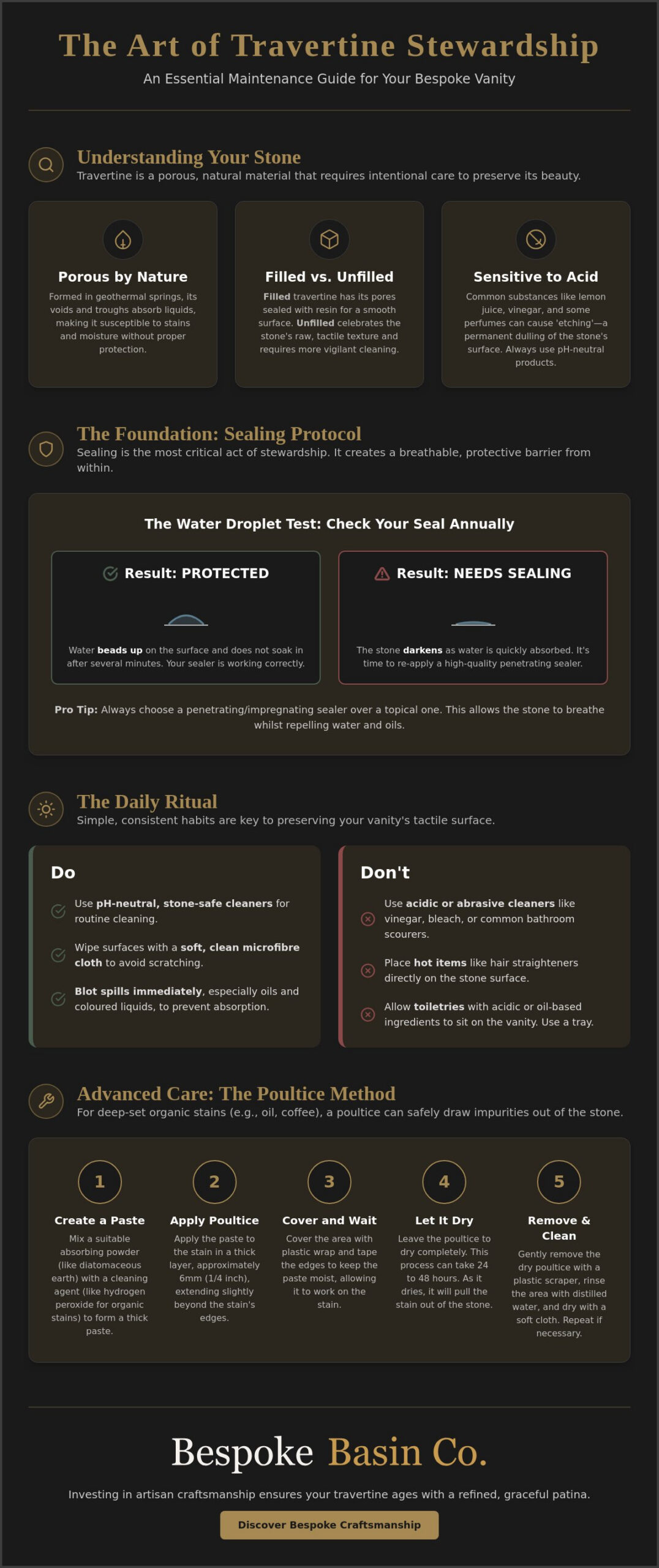
Travertine is born from the earth’s heat. It is a sedimentary rock formed by the rapid precipitation of calcium carbonate in geothermal springs. To truly understand What is Travertine, one must look at the voids and troughs that define its surface. These are not defects. They are the fingerprints of mineral-rich waters. This porous structure is precisely why a travertine vanity maintenance guide is essential for any homeowner. It is a material that breathes. It is a material that remembers.
The stone exists in a state of constant, subtle change. Unlike porcelain or quartz, travertine responds to its environment. It absorbs the history of a home through a developing patina. This evolution is a hallmark of natural materials. Whether your surface is honed to a soft satin or tumbled for a rustic, aged appearance, the stone will eventually tell the story of its use. It is a living surface that requires an intentional approach to preservation rather than a struggle for static perfection.
Stone Anatomy. The Filled and Unfilled Narrative
Artisans often distinguish between filled and unfilled stone. Filled travertine uses a colour-matched resin or cement to close the natural voids, creating a smoother, more uniform plane. Unfilled travertine remains raw. It celebrates the deep, tactile troughs of the earth. In a bathroom, moisture is a constant companion. The stone’s density determines how quickly it absorbs spills. Sedimentary stone is particularly susceptible to the humidity of a shower or the accidental splash of a tap. Understanding this relationship between density and absorption is the first step in successful stewardship. A filled surface provides a barrier against debris, whilst an unfilled surface requires more vigilant attention to ensure standing water doesn’t settle in its unique troughs.
Sensory Integrity. Preserving the Organic Surface
The appeal of a travertine bathroom vanity UK designers and homeowners specify lies in its tactile honesty. It feels cool and substantial. It possesses a matte, organic quality that synthetic materials cannot replicate. However, this sensory beauty is delicate. Acidic substances like lemon juice, vinegar, or certain high-end perfumes can “burn” the surface. This is chemical etching. It dulls the stone’s natural lustre and creates a permanent mark. You must balance the raw state of the material with the practical needs of daily hygiene. It’s not about avoiding use. It’s about using the stone with respect. By choosing the right cleansers, you protect the stone’s integrity without sacrificing the clean, clinical standards required in a modern washroom. It is a delicate dance between art and utility.
The Essential Foundation: Sealing and Protecting Your Vanity
Sealing is the most critical act of stewardship for natural stone. It is not a surface coating but a deep-seated protection. We must distinguish between topical waxes and impregnating sealers. An impregnating sealer enters the pores of the stone, creating a hydrophobic barrier whilst allowing the material to breathe. This is vital because travertine is a sedimentary rock. It needs to release internal moisture to prevent structural decay. This travertine vanity maintenance guide prioritises the use of these penetrating barriers to ensure the stone’s longevity.
The calcite structure of travertine is inherently sensitive to oils and moisture. Without protection, these liquids penetrate the voids mentioned in the previous section. A high-quality sealer sits just below the surface. It repels moisture, ensuring that spills bead up rather than soaking in. This is the core of any travertine care and maintenance routine. It preserves the stone’s internal integrity without masking its external beauty.
Testing the integrity of your surface is a simple, tactile process. Use the water droplet test. Place a few drops of water on the stone. If they bead and sit on the surface after several minutes, the sealer is intact. If the stone darkens and the water disappears, the barrier has failed. High-use environments like a family bathroom demand more frequent attention. Whilst some suggest sealing every few years, a bespoke vanity unit often benefits from an annual application to maintain its resilience against daily wear.
Choosing the Correct Sealant
Avoid topical coatings. They sit on top of the stone and can peel or yellow over time, obscuring the natural veining. Penetrating sealers are superior. They preserve the stone’s tactile quality. Choose non-toxic, solvent-free options. These are healthier for a bathroom environment where skin contact is frequent. A professional-grade sealer should not drastically change the stone’s colour. It should simply enhance its inherent depth and character. When you invest in a Travertine Vanity Unit, you are choosing a piece designed to age with grace through proper protection.
The Application Ritual
Preparation is a lesson in patience. The stone must be bone-dry. Any trapped moisture will cloud the finish. Clean the surface thoroughly to remove debris. Apply the sealer using a soft, lint-free cloth. Use deliberate, overlapping motions. Ensure every trough and void is saturated. After the stone has absorbed the liquid, wipe away the excess immediately. Curing is the final stage. Give the stone at least 24 hours to fully bond before introducing water. Patience is your most valuable tool in this process.
Daily Rituals and Care: Maintaining the Tactile Surface
The daily use of a bathroom is a sequence of small, physical interactions. Water splashes. Toothpaste settles. Perfume mists the air. In this environment, the travertine vanity maintenance guide shifts from structural protection to the quiet discipline of daily care. Stewardship is not about preventing use. It is about responding to it with intention. The stone is a record of your life. Proper care ensures that record remains one of beauty rather than neglect.
Wiping the surface is the most effective daily ritual. Use a damp microfibre cloth to remove standing water immediately after use. Water left to evaporate on the stone can lead to the build-up of mineral deposits, particularly in regions with hard water. These deposits cloud the stone’s natural colour and settle into the troughs of the texture. A simple, swift motion with a dry cloth after the morning routine preserves the clarity of the finish. It is a moment of maintenance that takes seconds but adds years to the stone’s life.
Contaminants are a constant presence in the modern washroom. Toothpaste often contains mild abrasives or whitening agents that can dull a honed finish. Hair products and perfumes frequently contain alcohol or oils that, if left unattended, can penetrate even a sealed surface. Treat every spill as a priority. Do not allow chemicals to sit. By maintaining a clean, dry surface, you allow the stone to remain a serene, tactile centrepiece amongst the chaos of a functional home.
Products to Embrace and Avoid
The “Acid Test” is the most vital concept to master. Travertine is composed of calcium carbonate. Acid dissolves this mineral on contact. Whilst many believe that vinegar or lemon juice are safe, “natural” alternatives, they are the stone’s primary enemies. They cause immediate chemical etching. Use only specialised, pH-neutral stone washes or a very mild, non-acidic soap. Avoid abrasive pads or scouring powders. These create micro-scratches that destroy the soft, satin feel of the stone. A soft cloth and a gentle touch are all the material requires.
Organising the Vanity Space
Prevention is a design choice. Utilise trays or coasters to hold soap dispensers and bottled products. This simple act prevents “ring” stains from moisture trapped beneath containers. Proper ventilation is equally essential. It ensures the stone dries thoroughly, preventing the growth of mould amongst the natural pores. When considering how to integrate these habits into a larger architectural vision, our guide to bespoke bathroom vanity units provides deeper context on the marriage of form and function. A well-organised space is a protected space.
Addressing Imperfections: Stain Removal and Minor Repairs
Stains are not failures of care. They are interruptions in the stone’s narrative. To address them effectively, you must first identify their origin. Organic stains, often from makeup or tannins, leave a faint shadow on the surface. Oil-based impurities from lotions or beard oils penetrate deeper into the calcite. Mineral deposits, or limescale, create a physical texture atop the stone. Each requires a different level of patience. This travertine vanity maintenance guide advocates for a slow, methodical approach to restoration.
Etching is distinct from staining. It is a chemical reaction that occurs when acid meets the stone’s calcium structure. It results in a dull spot that lacks the satin lustre of the surrounding area. Whilst minor etching can sometimes be softened with a fine-grit honing pad, deep reactions may require professional intervention. Knowing the limits of home maintenance is essential. A professional stone restorer has the tools to re-hone a surface to its original artisan standard without compromising its structural integrity. It is a matter of knowing when to act and when to consult a master.
The Artisan Poultice Technique. Drawing Out Impurities
For deep oil or organic stains, a poultice is the most effective remedy. Create a thick paste using bicarbonate of soda and distilled water. The consistency should resemble peanut butter. Apply the paste directly to the mark and cover it with plastic wrap, taping down the edges to create an airtight seal. Leave this for 24 to 48 hours. A poultice is a sacrificial layer that pulls deep-seated stains out of the stone via capillary action. As the paste dries, it draws the impurity into itself. Wipe away the dried residue with a soft cloth and repeat the process if a shadow remains.
Repairing Minor Chips and Voids. Restoring Integrity
Travertine is defined by its natural “holing.” Over time, some of these voids may expand or chips may occur at the edges of the unit. You can address these using a stone-grade epoxy or resin. Colour matching is a precise art. It involves blending pigments into the resin to mirror the stone’s unique palette of creams and ochres. Apply the filler with a small spatula, ensuring it sits slightly higher than the stone surface. Once cured, carefully smooth the repair with a high-grit abrasive until it matches the original honed texture. If you are starting a new project, selecting a high-quality Travertine Vanity Unit ensures a superior stone selection with fewer structural instabilities from the outset.
Ensuring Longevity: The Bespoke Approach to Natural Stone
A bespoke piece is a rejection of the temporary. It is an anchor in a world of mass-produced commodities. When you choose a travertine bathroom vanity UK architects and interior designers trust for high-end British homes, you are not merely selecting a fixture. You are commissioning a legacy piece. This stone has survived millennia in the earth. It is designed to survive decades in your home. This travertine vanity maintenance guide serves as the final chapter in the story of your vanity, moving from the artisan’s workshop to your daily life. Longevity is not an accident of the material. It is a result of the relationship between the object and its owner.
There is a quiet beauty in the concept of wabi-sabi. It is the appreciation of the imperfect and the evolving. Natural stone is a living surface. It will develop a patina that reflects the passage of time and the habits of those who use it. This evolution should be embraced rather than resisted. A well-maintained vanity unit doesn’t look “new” forever. It looks cared for. It looks substantial. By following a consistent ritual of care, you allow the stone to age with a refined grace that synthetic materials can never achieve. The integrity of the stone remains, whilst its character deepens.
- Annual Sealing: Perform the water droplet test every twelve months to ensure the internal barrier remains resilient.
- pH-Neutral Discipline: Reject any cleanser containing acids, bleach, or vinegar to prevent chemical etching.
- Immediate Response: Wipe away standing water and spills as they occur to prevent mineral build-up and staining.
- Intentional Placement: Utilise trays for toiletries to protect the stone from the oils and chemicals found in daily products.
The Designer’s Perspective on Maintenance
From an architectural standpoint, intentional maintenance is an investment in the resale and aesthetic value of your property. A custom made bathroom basin is a focal point. Its condition dictates the atmosphere of the entire room. Designers value travertine for its sensory warmth and tactile depth. Maintaining these qualities requires a specific understanding of the stone’s needs. If you encounter a unique challenge or require specialised advice, consulting with the studio ensures your maintenance routine aligns with the artisan standards used during production. There is a profound peace of mind that comes from owning an object finished by hand.
A Commitment to Quality
Our philosophy is rooted in permanence and the raw honesty of manual action. We believe that slow production creates objects that deserve slow care. Professional installation is the first step in this commitment. It ensures the stone is correctly supported and sealed, preventing long-term moisture issues before they begin. Every trough and void in our stone is a testament to our dedication to the material. If you are ready to begin your own journey with natural stone, Contact the studio for bespoke commissions and expert tiling advice. We are here to guide you through the spark of an idea to the finished, physical result.
Stewardship. The Future of Your Stone
Caring for a natural surface is an act of preservation. It honours the geological history of the material and the artisan’s dedication. You now have the tools to maintain the essential foundation of your stone through regular sealing and the quiet discipline of pH-neutral daily care. By following this travertine vanity maintenance guide, you ensure that your vanity remains a tactile centrepiece that tells a story of quality rather than neglect. The stone is a living record. It responds to your touch and the passage of time with a refined, graceful patina.
A bespoke object deserves a lifetime of respect. Our collection is hand-finished by master artisans, ensuring every detail reflects a commitment to manual action and permanent quality. We utilise only sustainably sourced natural stone, selecting slabs that possess both structural strength and aesthetic depth. With direct-from-studio installation across the UK, we ensure the continuity of our craft from our workshop to your home. Explore the Bespoke Basin Co. Collection of Travertine Vanities to discover a legacy piece for your bathroom. Trust in the material. Your stone will reward your patience with a beauty that only deepens with time.
Frequently Asked Questions
Is travertine too porous for a bathroom vanity?
Travertine is perfectly suited for a bathroom when handled with stewardship. Its porous nature is a geological fact, not a structural weakness. Correct sealing transforms these natural voids into a resilient, water-repellent surface. It requires more intention than synthetic materials, yet it offers a tactile warmth that porcelain cannot replicate. Proper care ensures the stone remains a durable centrepiece.
How often should I seal my travertine vanity unit?
We recommend sealing your surface once every twelve months. High-use environments like family bathrooms demand this annual ritual to maintain the stone’s internal barrier. You should utilise the water droplet test described in this travertine vanity maintenance guide to check the integrity of the sealer. If water no longer beads on the surface, it is time to reapply protection.
Can I use white vinegar to clean limescale off travertine?
White vinegar will cause immediate and permanent damage to your stone. It is highly acidic and reacts with the calcium carbonate in the travertine to create dull etch marks. To remove limescale, you must use a specialised, pH-neutral stone cleaner and a soft cloth. Patience and gentle, repetitive cleaning are far safer than aggressive chemical reactions that dissolve the stone.
What happens if I spill makeup or oil on my travertine basin?
Spills must be addressed with immediate, deliberate action. Blot the makeup or oil with a clean paper towel rather than rubbing it, which forces the liquid deeper into the stone’s pores. This travertine vanity maintenance guide recommends using a bicarbonate of soda poultice if a shadow remains. Quick responses prevent temporary accidents from becoming permanent records in the stone’s grain.
How do I tell the difference between a stain and an etch mark?
A stain is a change in pigment, whilst an etch is a change in the stone’s physical finish. Stains often appear as dark or discoloured shadows caused by absorbed liquids like makeup or wine. Etching looks like a dull, matte spot when viewed against the light. It is a chemical burn that has physically altered the surface texture of the stone.
Is it possible to repair a chip in a travertine countertop?
Minor chips and voids can be restored using stone-grade epoxy or resin. This process involves blending pigments to match the stone’s unique palette of creams and ochres. Once the filler has cured, it is sanded back to match the original honed finish. This restoration preserves the integrity of the piece without requiring a full replacement, maintaining the artisan quality of the surface.
Will my travertine vanity change colour over time?
Your stone will evolve and deepen in character as it ages. This development of a patina is a natural response to light, moisture, and use. It is a hallmark of living materials. Whilst the base colour remains stable, the surface will acquire a soft, weathered quality that reflects the history of your home. This evolution is part of the stone’s organic appeal.
Can I use a steam cleaner on my travertine surfaces?
Steam cleaners are too aggressive for the delicate structure of natural stone. The intense heat can shock the material and break down the protective sealer prematurely. Excessive moisture can also be forced into the troughs and voids of the stone, leading to long-term damp issues. Stick to damp microfibre cloths and pH-neutral solutions for a safer, more intentional clean.