
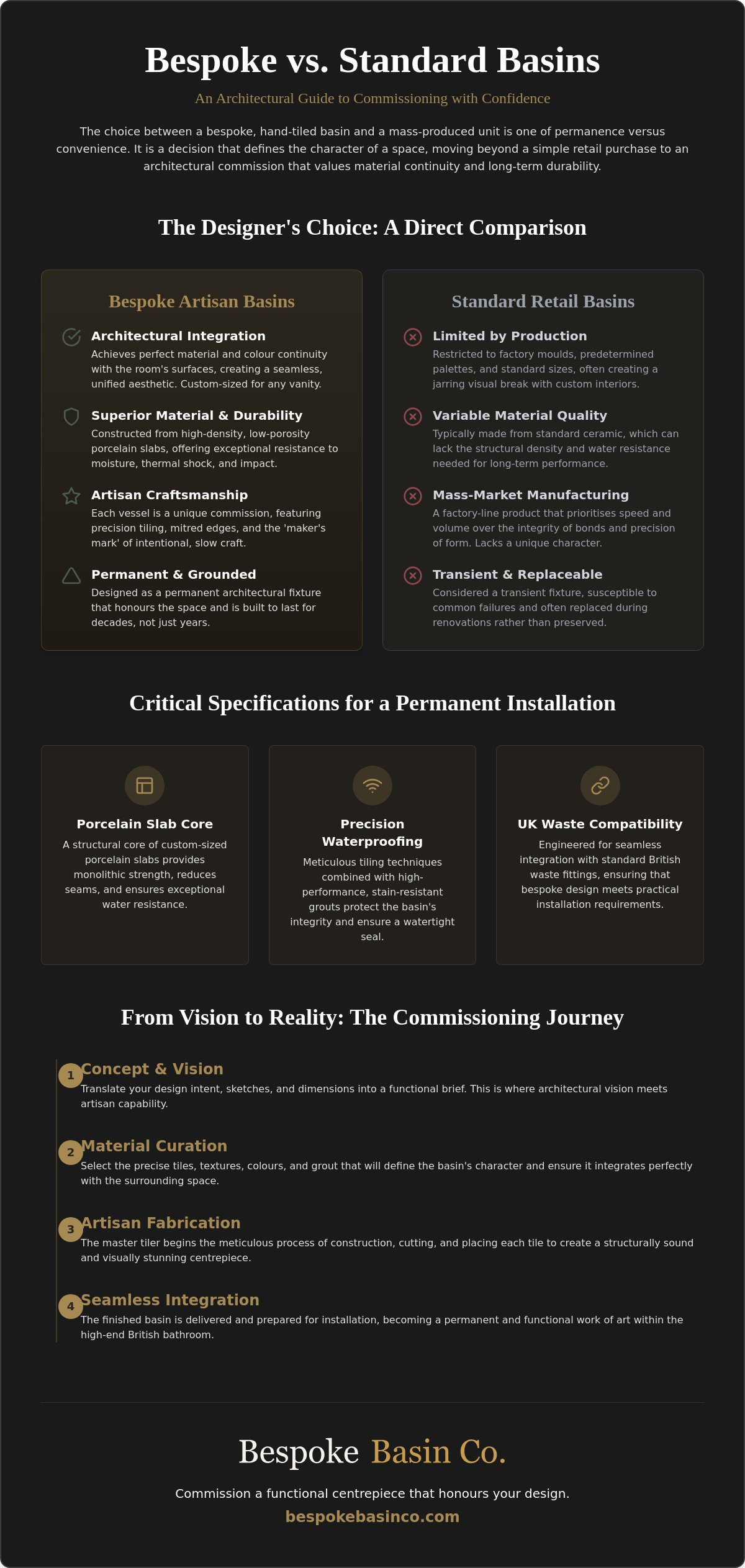
A basin isn’t a retail purchase. It’s a permanent architectural commission. For the designer, the choice between bespoke vs standard basins UK often rests on the tension between convenience and character. You understand that a mass-produced unit rarely satisfies the need for material continuity or the exacting dimensions of a custom vanity. There’s often a lingering concern regarding the integrity of the work, specifically the fear of failing grout or hidden leaks within a bespoke structure.
This guide provides the technical clarity and aesthetic framework required to commission a hand-tiled basin with total confidence. We explore the essential considerations for structural waterproofing, the precision of artisan tiling, and the seamless integration of these vessels into high-end British bathrooms. You’ll learn how to specify a functional centrepiece that honours the architecture of the space whilst ensuring long-term durability. It’s a journey from the initial sketch to a finished, physical result. Intentional design. Permanent quality.
Key Takeaways
- Understand the shift from mass-produced porcelain to intentional, artisan-led sanitaryware. Architectural continuity.
- Evaluate the technical benefits of bespoke vs standard basins UK. Focus on the moisture resistance and structural permanence of custom-sized porcelain slabs.
- Identify critical technical requirements for installation. Manage the weight of solid porcelain and ensure compatibility with standard UK waste fittings.
- Explore the sensory differences between factory-line products and a hand-tiled vessel. The maker’s mark.
- Gain clarity on the commissioning process. Translate your vision into a functional centrepiece with accurate dimensions and curated textures.
The Rise of the Hand Tiled Sink. A New Permanence.
A hand-tiled sink is more than a bathroom fixture. It is a deliberate architectural commission. In these vessels, the surface and structure merge into a single, cohesive form. This represents a significant shift amongst UK designers. We are seeing a move away from mass-produced porcelain towards intentional, artisan-led sanitaryware. When considering the history of the modern sink, the evolution of the home has led us back to the value of the maker’s hand. It is a return to substance.
The choice between bespoke vs standard basins UK often rests on the limits of retail production. Standard units are restricted by factory moulds and predetermined palettes. They are transient. A hand-tiled sink, by contrast, occupies space with quiet authority. It offers a level of colour and texture customisation that is impossible to replicate with off-the-shelf products. You can specify the exact grout width, the precise tile orientation, and the weight of the rim. It is a choice for those who value permanence over the temporary.
Artisan Integrity. Beyond the Surface.
There is a profound sensory connection in a hand-tiled vessel. Each tile is placed with intention, creating a tactile surface that invites touch. This is the essence of slow making. Unlike rapid retail manufacturing, this process prioritises the integrity of the bond and the precision of the line. The master tiler is not merely an installer. They are a guardian of structural longevity. Their work ensures that the basin remains a functional centrepiece for decades. It resists the common failures of mass-market alternatives. The result is a product that feels honest and grounded.
Material Continuity in UK Interiors
In luxury British homes, the goal is often a seamless flow. Using bespoke tiled basins UK allows the designer to extend the visual language of the walls and floors directly into the vanity unit. The basin becomes an extension of the room’s skin. This continuity eliminates the jarring visual breaks often caused by standard white ceramic. It allows for a contemporary British aesthetic that feels both modern and timeless. By matching the basin tiles to the surrounding environment, you create a space that feels unified. It is a sophisticated approach to interior design that values depth and material honesty. Every detail is considered. Nothing is left to chance.
Material Honesty. Porcelain Slabs and Precision Tiling.
Material selection is an act of foresight. For the architect, the decision between bespoke vs standard basins UK is a choice between a surface that merely looks the part and one that performs under pressure. Porcelain is the definitive choice for hand-tiled vessels. Its low porosity makes it ideal for high-moisture environments where traditional ceramic often fails. Standard ceramic tiles, whilst beautiful, frequently lack the structural density required for a permanent water-holding structure. Porcelain, high-fired and resilient, offers superior resistance to both thermal shock and physical impact. It doesn’t just sit on the surface. It endures.
This technical superiority aligns with the rigorous requirements of BS 5385-4:2015 for wet rooms, ensuring the installation remains airtight and stable over time. In a UK household, where daily use involves constant temperature fluctuations and hard water exposure, selecting high-grade materials is not a luxury. It’s a necessity for longevity. The choice of bespoke vs standard basins UK is often a choice between a mass-produced shell and a tailored architectural element that respects the physics of the bathroom.
The Strength of Custom Porcelain Slabs
The foundation of our work lies in custom-sized porcelain slabs. These large-format pieces provide the necessary rigidity to support intricate tiling work. By using slabs as a structural core, we significantly reduce the number of visible seams in complex basin designs. This creates a cleaner, more monolithic aesthetic that feels part of the building itself. The density of high-fired porcelain is the key to its exceptional water resistance.
Tiling Techniques for Sanitaryware
Precision is everything. The master tiler employs mitred edges to create seamless transitions between surfaces, a task that demands a steady hand and a deep understanding of the material’s behaviour. Grout selection is equally critical. We specify high-performance grouts that resist staining and moisture, protecting the integrity of the intricate tile patterns. The artisan organises the tile layout with a focus on visual impact, ensuring that every line serves the overall architecture of the basin. It’s a methodical process. Every cut is intentional. Every joint is precise. This level of detail ensures the basin remains a functional centrepiece for the long term.
The Maker’s Mark. Artisan Craft vs. Retail Production.
A factory cannot replicate the soul of a workshop. The fundamental distinction in the debate of bespoke vs standard basins UK lies in the maker’s mark. Retail production prioritises the economy of scale, resulting in objects that are technically competent but emotionally vacant. These off-the-shelf basins lack the character and depth of a commission. A studio-made hand tiled vessel basin is different. It is an object born from direct collaboration. By working closely with the maker, you ensure that the final piece respects the specific constraints of your project. This level of involvement eliminates the risks of subcontracted labour, where the original design intent is often lost amongst layers of disconnected tradespeople.
In the artisan world, there is no room for the generic. Every basin is a unique response to a brief. Standard units are designed to fit everyone and, consequently, fit no one perfectly. They lack the nuanced textures and the weight of a hand-built structure. Choosing a bespoke commission is an investment in integrity. It is a commitment to a standard of quality that refuses to cut corners. It is about the honesty of the material and the dedication of the person who handled it. This is where art meets utility. Architects specifying bespoke basins for commercial projects will find that this same philosophy of workshop precision and tactile materiality translates directly into high-traffic environments, where durability and character must coexist.
The Artisan Journey. From Sketch to Stone.
The creation of a bespoke basin is a methodical progression. It begins with an initial drawing, where dimensions are refined to suit the specific vanity unit. Every step requires manual action and personal involvement. The master tiler ensures that every mitre is perfect and every bond is secure. This staccato rhythm of work-measure, cut, set, check-defines the studio environment. It is a process that values precision over speed. The result is a piece that possesses an uncompromising standard of finish. It is a journey from a spark of an idea to a finished, physical object that you can touch and feel.
The Value of Patience. Quality over Speed.
Lead times are a hallmark of quality. In the artisan world, a wait of several weeks is expected. It is a sign of dedication. Fast production in sanitaryware often leads to catastrophic failures, such as delamination or poor sealing. These issues are rarely visible at the point of sale but manifest quickly under the rigours of daily use. A hand-tiled basin is built to age gracefully. It is designed for longevity, using techniques that ensure the structure remains airtight for decades. You aren’t just buying a sink. You’re investing in a permanent architectural fixture that will endure within the home. Quality takes time. Substance requires patience.
Technical Specification. Designing for UK Wet Rooms.
Precision is not just an aesthetic choice. It’s a technical requirement. When evaluating bespoke vs standard basins UK, the architect must look beyond the surface to the structural reality of the installation. A hand-tiled basin, constructed from solid porcelain and artisan tile, possesses a significant mass. It’s an architectural weight. Consequently, vanity units must be specified to support this density without deflection. It’s a consideration often overlooked with the lightweight retail alternatives found in the mass market. We ensure the substructure is as resilient as the finish. It’s about the physics of the room.
Waterproofing is handled with a methodical, multi-layer protocol. It’s a process of total encapsulation. We apply high-performance tanking membranes to the structural core before any tile is laid, creating a redundant barrier against moisture. This rigour ensures a leak-proof vessel that exceeds the standards required for modern UK wet rooms. We don’t rely on the tile alone for water integrity. The structure itself is an impenetrable shell. It’s about the integrity of the build. It’s about peace of mind for the homeowner.
Integrating with UK Plumbing Standards
A bespoke commission must function within the existing infrastructure of the home. Our designs accommodate standard UK 32mm or 40mm waste fittings, ensuring compatibility with domestic drainage systems. We coordinate closely with site plumbers to ensure seamless transitions between the first and second-fix stages. This eliminates the friction often found with imported fixtures, highlighting the practical advantage of bespoke vs standard basins UK for complex layouts. Designers specifying a wall mounted tiled basin UK will find that these same plumbing considerations apply, with the added structural demands of a floating vessel requiring careful substrate engineering. To ensure the highest standard of finish, we recommend our bespoke tiling services for final integration. Professional installation is the final step in the artisan journey.
Longevity and Maintenance
Preserving the artisan finish requires a gentle touch. We recommend cleaning protocols that utilise pH-neutral soaps to protect both the porcelain tiles and the grout integrity. Abrasive chemicals should be avoided, as they can dull the hand-crafted surface over time. Maintenance is simple when the materials are high-grade. Epoxy grouts are the gold standard for tiled basin hygiene due to their non-porous and stain-resistant properties. It’s a choice for longevity. It’s a choice for the future of the home.
The Commissioning Process. Bringing Your Vision to Life.
A commission is a partnership. It is a deliberate dialogue between the designer’s vision and the maker’s technical expertise. When navigating the choice of bespoke vs standard basins UK, the process begins long before the first tile is cut. It starts with a definition of the aesthetic. You choose the specific tile types, the depth of the colour, and the texture of the surface. Every element is selected to resonate with the wider interior. This phase requires a high degree of precision. Providing accurate dimensions for custom-sized porcelain slabs is vital. These measurements form the structural skeleton of the vessel, ensuring it fits the vanity unit with millimetre accuracy. It is a process that values exactness over estimation.
Initiating a project is a straightforward progression. Whether you are specifying a bespoke basin for commercial projects or a single residential commission, the studio provides the necessary guidance to refine the technical brief. We finalise the design details together. We confirm the manufacturing schedule. This transparency allows for a seamless integration into the wider construction timeline. It removes the uncertainty often associated with custom work. You gain confidence in the structural integrity of the piece before it ever leaves the workshop. It is a journey of shared dedication.
Collaboration and Design Development
The design stage is an opportunity for refinement. We work with you to perfect the Organic Vessel Basin shape, ensuring the curves or angles meet the ergonomic needs of the space. We often select complementary materials during this phase, such as pairing the tiled basin with a Travertine Vanity Unit for a grounded, sensory finish. Samples play a critical role here. They allow you to confirm the final texture and colour palette under the specific lighting of the site. It is about the physical reality of the materials. No detail is too small.
From Workshop to Installation
The transition from workshop to site is handled with care. We manage the transport of our artisan basins across the UK, ensuring each piece arrives in pristine condition. In-house installation is a vital component of our service. It maintains the integrity of the work and ensures the waterproofing remains uncompromised during the final fit. The process concludes with a formal handover. This marks the beginning of the object’s life in your space. It is a permanent architectural fixture. It is a finished, physical result. The choice of bespoke vs standard basins UK is ultimately a choice to invest in a piece that will endure.
Architectural Integrity. The Permanent Choice.
Specifying a hand-tiled basin is an act of architectural foresight. It represents a deliberate choice for material honesty and technical precision. We’ve explored how high-fired porcelain slabs provide a structural foundation that mass-market ceramic cannot match. You now understand the necessity of artisan involvement from the first sketch to the final grout line. This is design that respects the physics of the space. It is a return to substance.
The decision between bespoke vs standard basins UK is ultimately a question of integrity. At Bespoke Basin Co., we operate as a dedicated artisan studio. We avoid all subcontracted labour to ensure that every mitre and every bond meets our uncompromising standards. As specialists in high-end porcelain slab integration, we provide expert in-house installation across the UK. This ensures that the structural vision you have designed is the one that is physically realised in the home. We invite you to begin the dialogue for your next project.
Begin your bespoke commission with Bespoke Basin Co.
Frequently Asked Questions
Is a hand-tiled sink harder to clean than a standard porcelain basin?
Cleaning a hand-tiled sink is as straightforward as maintaining any premium porcelain surface. We use non-porous epoxy grouts that resist dirt, mould, and bacteria, ensuring the basin remains as hygienic as a standard retail unit. Regular maintenance with a pH-neutral soap prevents the buildup of limescale without damaging the artisan finish. It’s about using the right materials for a permanent, practical result.
Can I use any tile for a bespoke tiled basin?
Porcelain is the definitive material for these commissions due to its exceptional density and low water absorption. Whilst some ceramic or natural stone tiles can be used, they often require specialist sealing to withstand constant water exposure in a basin environment. We evaluate every tile for its structural suitability before the work begins. This ensures the vessel remains airtight and durable for the long term.
How do I ensure a hand-tiled sink is completely waterproof?
We ensure total water integrity through a methodical, multi-layer tanking protocol applied to the structural porcelain core. We don’t rely on the tile or grout alone for water resistance. Instead, we encapsulate the entire vessel in a high-performance membrane before the first tile is set. This rigorous approach exceeds standard UK wet room requirements, providing a redundant barrier against hidden leaks and moisture penetration.
Will the grout discolour over time in a hand-tiled sink?
Epoxy grout does not discolour because it is chemically non-porous and resistant to staining. Unlike traditional cementitious grouts, epoxy does not absorb pigments, oils, or soaps from daily use. This choice is vital when considering bespoke vs standard basins UK, as it preserves the visual clarity of your design for decades. The colour you choose at the workshop is the colour that remains in your home.
Are hand-tiled sinks suitable for high-traffic commercial environments in the UK?
Bespoke tiled basins are exceptionally resilient and highly suitable for luxury commercial spaces where durability is paramount. The solid porcelain structure and impact-resistant tiles withstand the rigours of frequent use better than many lightweight retail alternatives. We specify high-grade materials that meet the specific demands of the project, ensuring the basin remains a functional centrepiece in hotels or restaurants across the UK. Our dedicated guide to bespoke basins for commercial projects explores how artisan utility and workshop precision meet the demands of high-traffic environments in greater detail.
What kind of vanity unit do I need to support a bespoke tiled basin?
The vanity unit must be specified to support the architectural weight of a solid porcelain and tiled structure. These vessels possess a significant mass compared to standard ceramic shells, requiring a unit made from reinforced timber or a steel-framed structure. This structural requirement is a key factor when comparing bespoke vs standard basins UK, as off-the-shelf units are often designed for much lighter fixtures.
Can you create a hand-tiled sink to match my existing wall tiles?
Matching the basin to your existing wall tiles is a core benefit of a bespoke commission and creates total material continuity. We frequently use the same tiles specified for the walls or floors to ensure the basin feels like an organic extension of the room’s architecture. This eliminates the jarring visual breaks caused by standard white ceramic. It allows for a unified, sophisticated aesthetic that respects the wider interior design.
How long does the commissioning process for a hand-tiled sink typically take?
A typical commission requires a lead time of six to eight weeks from the finalisation of the design. This timeline reflects the slow making philosophy of our studio, allowing for the meticulous cutting, setting, and curing required for a permanent fixture. We don’t rush the work. Every stage is handled with patience to ensure the integrity of the final object. This dedication is what separates artisan craft from rapid retail production.