
The most intimate spaces in a home deserve more than the hollow convenience of a mass-produced fixture. A basin shouldn’t just be a utility. It should be a permanent anchor. You’ve likely felt the frustration of searching for a unique focal point only to be met by the ubiquity of generic retail basins. There is a growing desire for something more substantial. True bespoke interior basin design is no longer about simple dimension adjustments. It’s about the raw honesty of manual labour and the quiet weight of stone and porcelain.
We understand the need for material integrity in high-end residential projects. This study explores the shift toward organic, hand-tiled forms that offer a sensory connection to the maker. You’ll learn how to specify these sculptural elements to ensure they serve as enduring architectural statements. We’ll guide you through the transition from fleeting trends to the value of slow production. It’s a journey from the initial spark of an idea to a finished, physical result that respects the passage of time.
Key Takeaways
- Understand the shift from mass-produced utility toward a philosophy of architectural permanence, where the basin serves as a sculptural anchor.
- Explore the sensory qualities of travertine and porcelain slabs, identifying how these materials elevate the integrity of a bespoke interior basin design.
- Recognise the emerging aesthetic of organic vessel basins that mimic natural forms, bringing a tactile and hand-crafted artistry to the modern bathroom.
- Learn the practical considerations for specifying hand-tiled vessels to ensure they meet the rigorous durability requirements of high-end residential projects.
- Gain insight into the artisan commissioning journey, moving methodically from the initial conceptual spark to a finished, physical result.
The Evolution of Bespoke Interior Basin Design. From Utility to Artistry.
A basin is a vessel for water. It is also a sculpture. True bespoke interior basin design exists at the precise intersection of architecture, sculpture, and utility. It is where the fluid needs of a home meet the unyielding weight of physical presence. For decades, sanitaryware was treated as a secondary component. It was a mass-produced afterthought. Today, there is a profound shift amongst UK designers toward the unique and the hand-crafted. They are moving away from the assembly line.
This evolution is driven by a desire for architectural permanence. A bespoke basin serves as the anchor of a high-end project. It provides a sense of gravity that off-the-shelf fixtures cannot replicate. In an intentional space, every object is chosen for its integrity and tactile quality. The goal is to create an environment that feels grounded. It is about the continuity of the maker’s hand and the raw honesty of the materials used. The basin is no longer just a functional requirement; it is a statement of dedication to the craft.
The Decline of the Off-the-Shelf Aesthetic.
Standardised luxury has become a contradiction in terms. Many high-end homeowners find that retail showrooms offer a repetitive aesthetic that lacks soul. This ubiquity has led to a resurgence of the independent artisan studio. Designers now seek authentic, one-of-a-kind pieces that cannot be found in a catalogue. Choosing a bespoke route allows for total control over the nuances of colour, texture, and form. It ensures that the sanitaryware is not merely placed in a room but is fundamentally part of its structure. It is a move from the temporary to the enduring.
The Basin as an Architectural Focal Point.
The basin occupies a unique place in the home. It is often the first object a user touches in the morning and the last they see before sleep. This repetitive interaction creates a sensory connection between the individual and the object. There is a distinct psychological impact when using a hand-crafted vessel. You feel the density of the stone and the texture of the glaze. It elevates a mundane ritual into a moment of connection with the material world. Bespoke basin design is a rejection of the temporary in favour of the permanent.
Material Integrity in the Modern Workshop. Porcelain and Travertine.
The workshop is a place of patience. It is where raw materials are transformed into enduring objects through manual labour and focused intent. In the context of bespoke interior basin design, the choice of material is never a superficial decision. It is a commitment to longevity. Porcelain and travertine have emerged as the primary mediums for this work. Each material offers a distinct dialogue between form and function. Whilst porcelain provides a canvas of technical precision, travertine offers the irregular, sensory beauty of the earth itself.
Working with hand-tiled vessels presents significant technical challenges. It requires a level of precision that cannot be automated or rushed. Every tile must be set with an intimate understanding of how water moves across a surface. The reward is a texture that feels human and intentional. These materials possess a raw honesty. They age gracefully. They maintain their structural integrity whilst developing a subtle patina that tells the story of the home. This connection to the maker is what separates an artisan piece from a factory product. It is a journey from the raw state to a refined, architectural anchor.
The Versatility of Porcelain. Custom-Sized Slabs.
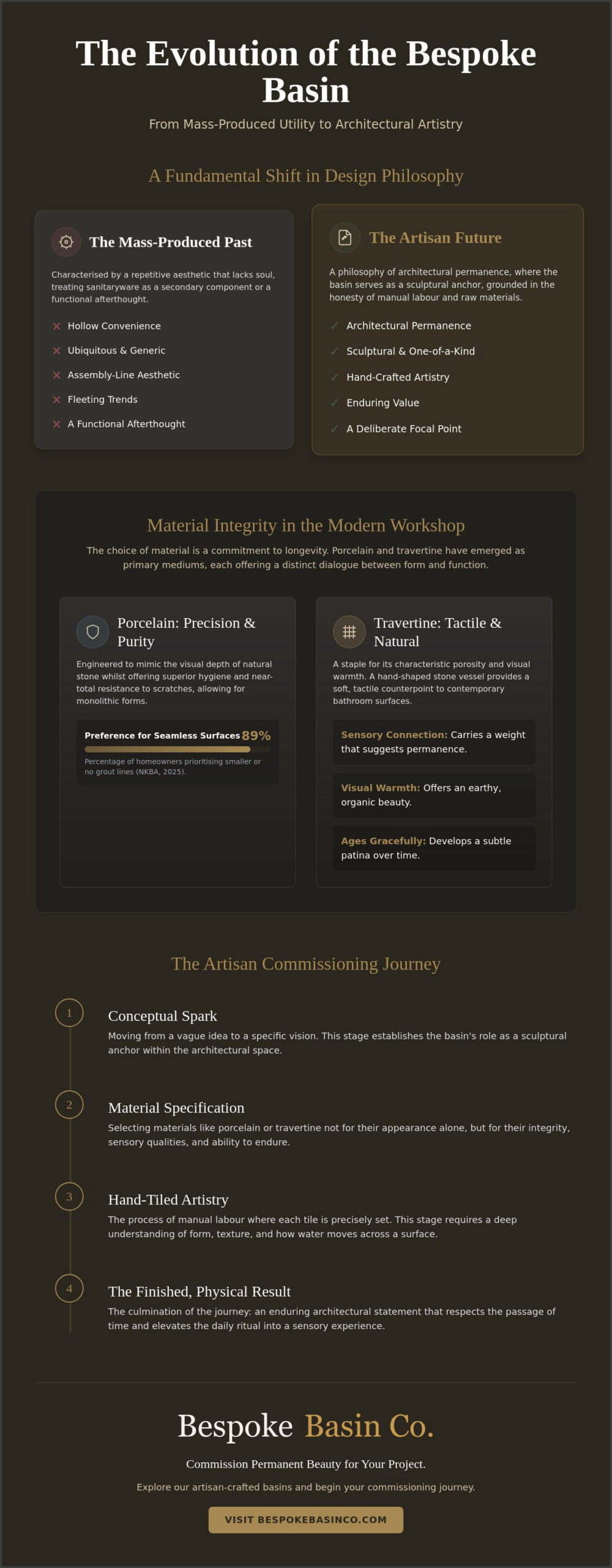
Modern porcelain is a remarkable feat of engineering. It mimics the visual depth of natural stone whilst offering superior hygiene and near-total resistance to scratches. A 2025 survey by the National Kitchen & Bath Association found that 89% of homeowners now prioritise smaller or no grout lines. This preference for seamless surfaces drives the artisan process of mitring and joining custom-sized porcelain slabs. The result is a monolithic form that appears as if it were carved from a single block. It is a clean-lined aesthetic rooted in the physical traditions of the workshop. The same technical rigour that defines residential commissions also underpins the specification of bespoke basins for hotels UK, where high-performance porcelain must meet the demands of commercial longevity.
The Tactile Appeal of Stone. Travertine and Natural Form.
Travertine remains a staple amongst British designers. Its appeal lies in its characteristic porosity and its visual warmth. A travertine vanity unit provides a soft, tactile counterpoint to the often cold surfaces of a contemporary bathroom. There is a profound sensory connection to stone that has been shaped by hand. It feels cool to the touch and carries a weight that suggests permanence. For those weighing the merits of different artisan finishes, our guide on Tiled vs Travertine Vanity offers a deeper look into material selection. If you are ready to begin your own commission, exploring our collection of hand-tiled vessels can provide the necessary starting point for your sanctuary.
Defining the Aesthetic of 2026. Organic Forms and Hand-Tiled Textures.
The design landscape of 2026 signals a definitive move away from the clinical and the sterile. It is a return to the grounded. In the world of bespoke interior basin design, this is manifested through a focus on “maximalist texture” and earthy, resonant colour palettes. We see a shift toward sage greens, deep terracottas, and ochre tones that anchor a room. These choices reflect the wider movement of slow making. Every object is a testament to patience. It is an intentional rejection of mass-produced uniformity in favour of pieces that carry the weight of their own creation.
This aesthetic is not about flashiness. It is about substance. The bathroom is being reimagined as a sanctuary where the physical state of every material is considered. By moving away from sterile whites, designers are creating spaces that feel atmospheric and layered. The basin acts as the primary vehicle for this transition. It is the tactile centrepiece of the room. It bridges the gap between the practical needs of the user and the artistic vision of the architect.
The Rise of the Organic Vessel Basin.
Sharp, aggressive lines are being replaced by softened edges. The organic vessel basin mimics the asymmetrical shapes found in the natural world. It feels more like a stone smoothed by a river than a product of a factory. Tiling these complex, curved forms represents the pinnacle of artisan skill. It requires an exactness that cannot be replicated by machines. For a deeper exploration of how these forms integrate into high-end projects, our Bespoke Tiled Basins UK guide provides an architectural framework for selection.
Hand-Tiled Vessels as Functional Art.
There is a rhythmic beauty in hand-laid tiles. Each piece carries a subtle variation. These inconsistencies are not flaws; they are the proof of human involvement. A hand-tiled vessel basin adds a layer of depth and shadow to a bathroom centrepiece that a flat surface lacks. The way light catches the edges of the grout and the glaze creates a dynamic, living object. Running your hand across the cool, rhythmic ridges of a bespoke tiled surface offers a grounding sensory experience that connects the user to the very act of making. It is functional art that prioritises the tactile over the merely visual.
Specifying for Longevity. Practical Considerations for High-End Interiors.
Permanence is the ultimate luxury. When specifying bespoke interior basin design, the focus must shift from the immediate visual impact to the quiet endurance of the object. A 2025 survey by the National Kitchen & Bath Association found that 91% of homeowners prioritise durability and practicality to minimise upkeep. This isn’t just a trend. It’s a demand for material integrity. A hand-crafted vessel is not a delicate ornament. It’s a functional anchor designed to withstand the daily rituals of the home for decades. Achieving this requires a seamless continuity between the design, the manufacturing, and the final placement.
Integrity is found in the audit trail. We believe the studio that creates the piece must be the one that oversees its journey into the space. Avoiding subcontracted labour prevents the fragmentation of responsibility. It ensures that the artisan who understands the specific density of the porcelain or the porosity of the travertine is the one ensuring its structural support. This in-house approach is the only way to guarantee that the architectural vision remains uncompromised by the shortcuts of mass installation. It’s a journey of dedication.
The Critical Nature of Installation. Studio-Led Precision.
The weight of a travertine vanity unit or a monolithic porcelain slab demands more than standard plumbing. It requires an understanding of structural load and watertight integrity. The hand that tiles the vessel should be the hand that secures it. This prevents the common pitfalls of mismatched tolerances or compromised seals. During this phase, the artisan acts as a trusted partner to the architect. We provide the technical clarity needed to ensure the basin feels like a permanent part of the building’s fabric. It’s about precision. It’s about the finality of a perfectly set joint. Architects specifying storage alongside sanitaryware will find that our guide to a custom tiled vanity unit addresses the same principles of structural load, material integrity, and studio-led installation in equal depth.
Maintenance and the Passage of Time. Enduring Beauty.
There’s a persistent myth that artisan work is fragile. The reality is often the opposite. Hand-crafted pieces are engineered with a depth of material that factory-made alternatives lack. Caring for these surfaces is a matter of respecting the material. Neutral cleaners and regular sealing for natural stone ensure that the basin ages with grace rather than wear. To see how these principles are applied in practice, read our Bespoke Basin for Residential Project case study. If you’re ready to integrate these permanent forms into your next scheme, you can explore our bespoke tiling services to begin the process.
For architects, the specification process should include:
- Verification of material weight against the subfloor and wall structure.
- Compliance with the UK Mandatory Water Efficiency Labelling (MWEL) 2026 for any integrated brassware.
- A clear maintenance schedule tailored to the specific porosity of the stone or porcelain.
- Confirmation of in-house manufacturing to ensure a direct line of accountability.
The Artisan Approach. Commissioning Permanent Beauty.
The journey of a commission begins with a spark. It is a moment where an architectural vision meets the practical possibilities of the workshop. Unlike a corporate transaction, bespoke interior basin design is an intimate collaboration. It requires a thoughtful guide who understands the nuances of the material. We refuse to cut corners. Every joint is considered. Every tile is placed with intent. This dedication ensures that the final object is not just a fixture but a piece of permanent beauty that resonates with the soul of the home. It is a process that values depth over speed.
Bespoke Basin Co. stands as a guardian of quality in the UK bespoke tiling industry. We believe that the integrity of the finished product is a direct result of the patience invested during production. In a world of fleeting trends, we focus on the enduring. Our workshop is a place where manual labour is respected and where the raw honesty of natural materials is celebrated. We are not merely service providers. We are partners in the creation of spaces that feel grounded and intentional. Every project is a testament to the value of slow making. This same philosophy extends beyond the private home; those specifying unique tiled sanitaryware for hotels across the UK will find that the principles of structural integrity and artisan fabrication are equally essential in high-traffic hospitality environments.
The Collaborative Design Process.
Architects and designers come to us to realise visions that cannot be found in a showroom. The flexibility of a custom commission allows for total alignment with the wider interior scheme. We offer bespoke sizes, colours, and textures that respect the unique constraints of each project. Whether it is a custom-sized porcelain slab or an organic vessel basin, the process is entirely bespoke. Those who also require integrated storage solutions will benefit from understanding how a custom tiled vanity unit can be specified to the same standard of artisan precision, ensuring the entire bathroom scheme maintains a unified architectural language. The commission process is a narrative of patience and dedication, where the abstract becomes tangible through the steady movement of the artisan’s hands.
A Legacy of Slow Making.
There is pride in the slow way. The time taken to hand-tile a vessel is reflected in the depth and quality of the final piece. It carries a weight that mass-produced alternatives can never achieve. Owning an object meticulously crafted amongst the dust and noise of a real workshop creates a lasting connection between the owner and the maker. It is a sensory reminder of the human element in architecture. We invite you to bring this sense of permanence into your next project. Explore the collection of hand-tiled vessels and bespoke designs.
The Future of the Sanctuary. Permanent Form.
The modern bathroom is no longer a clinical space. It is a sanctuary defined by architectural permanence. We’ve explored how bespoke interior basin design has moved beyond mere customisation to become a philosophy of hand-crafted artistry. You’ve seen the value of material integrity found in custom-sized porcelain slabs and the raw, sensory beauty of a travertine vanity unit. Choosing an artisan studio means choosing a legacy of slow making. It ensures every object carries the quiet weight of its own creation. It’s a rejection of the temporary in favour of the enduring.
In-house manufacturing and installation remain the only ways to guarantee this uncompromising standard of quality. It’s about a direct connection between the maker, the material, and the final placement within your scheme. We’re dedicated to the workshop traditions that prioritise depth over speed. Your home deserves a focal point that respects the passage of time whilst grounding the daily ritual. Let’s begin the journey from the initial spark of an idea to a finished, physical result.
Commission your unique interior basin design today
Frequently Asked Questions.
What is the difference between a custom basin and a bespoke interior basin design?
A bespoke interior basin design is a ground-up architectural commission rather than a simple adjustment of an existing product’s dimensions. Whilst “custom” often refers to choosing a colour or size from a pre-set list, a bespoke piece begins with a unique vision. It involves a collaborative dialogue regarding form, material integrity, and the specific requirements of the project. It’s the difference between a modified factory item and a hand-crafted anchor.
How long does it typically take to commission a hand-tiled vessel basin?
A hand-tiled vessel basin typically requires a lead time of several weeks to ensure the integrity of the slow-making process. Every tile is laid by hand with focused intent. This timeframe allows for the necessary curing of adhesives and the meticulous finishing of grout lines. We don’t rush the workshop journey. Patience is a requirement for creating an object that’s intended to last for decades within a home.
Are bespoke porcelain basins more durable than standard ceramic sinks?
Porcelain is significantly more durable than standard retail ceramic due to its density and scratch-resistance. It’s a non-porous material that withstands the rigours of high-traffic luxury environments whilst maintaining its aesthetic depth. Standard ceramic sinks are often mass-produced and prone to chipping. A bespoke porcelain piece offers superior hygiene and a structural permanence that retail alternatives cannot match. It’s a commitment to material honesty.
Can I specify a travertine vanity unit in a custom size for a small bathroom?
You can specify a travertine vanity unit in any dimension to suit the constraints of a small bathroom. Bespoke sizing is a fundamental aspect of the bespoke interior basin design process. We work with architects to ensure the stone is scaled correctly for the space without losing its sculptural impact. Even in a compact setting, the raw, porous beauty of travertine provides a grounded focal point that feels intentional and permanent.
Is professional installation included with Bespoke Basin Co. commissions?
Studio-led installation is a core part of the commissioning process to ensure the long-term integrity of the work. We don’t believe in subcontracting this critical phase to general plumbing repairs. The same artisan who manufactured the piece oversees its placement. This ensures that the structural support and watertight seals meet our uncompromising standards. It provides a direct line of accountability from the workshop to the finished room.
How do I maintain the finish of a hand-tiled basin over time?
Maintaining a hand-tiled basin involves using pH-neutral cleaners and avoiding aggressive chemicals that might compromise the grout or glaze. Regular rinsing with clean water prevents the build-up of limescale. For natural stone elements, periodic sealing is required to protect the material’s inherent porosity. It’s a simple ritual of respect. These objects are designed to age gracefully, developing a subtle patina that reflects the passage of time.
What materials are best for a bespoke wet room basin in the UK?
Porcelain slabs and hand-tiled vessels are the most effective materials for a bespoke wet room basin. These materials offer the necessary resistance to humidity and constant water contact. Porcelain is particularly valued for its low absorption rate and ease of maintenance. When combined with professional, studio-led installation, these materials provide a seamless architectural finish that integrates perfectly with the wider wet room environment.
Do you work with interior designers on large-scale residential projects?
Collaborative commissions with interior designers are the foundation of our studio’s work on large-scale residential projects. We act as a thoughtful guide throughout the process. From the initial conceptual spark to the final installation, we provide the technical clarity needed to realise complex visions. We value the relationship with design professionals who appreciate the nuances of custom work and the integrity of natural materials.