
A bathroom is only as permanent as its weakest material. Precision. Longevity. Most luxury interiors are compromised by generic, off-the-shelf basins that fail to respect the unique dimensions or the specific textures of a thoughtfully designed room. It’s a common frustration amongst designers who seek a seamless flow between the wall and the fixture. You likely want a space where every element feels intentional rather than merely installed, yet concerns regarding grout hygiene and technical durability often stall the creative process.
Choosing a hand crafted tiled sink allows for a level of architectural integration that standard ceramic simply cannot match. This guide explores the technical precision and material artistry required to commission a bespoke piece for high-end British bathrooms. We will examine the structural integrity of custom-sized porcelain slabs, the reality of modern grout performance, and the rigorous design considerations that ensure your basin meets BS EN 14688:2015 standards. Discover how the raw honesty of manual labour transforms a functional vessel into a permanent, tactile feature of the home whilst solving the practical challenges of non-standard spaces.
Key Takeaways
- Understand why designers are moving away from mass-produced sanitaryware towards intentional, tactile surfaces that respect the unique dimensions of a room.
- Learn about the structural engineering of a hand-tiled vessel, including the critical importance of waterproofing and a lightweight, sound substrate.
- Explore the aesthetic and functional benefits of using custom-sized porcelain slabs over natural stone to achieve a seamless, durable finish.
- Gain a practical framework for specifying a hand crafted tiled sink within a larger design brief, ensuring perfect integration with existing wall or floor tiling.
- Discover the collaborative journey from initial concept to the final workshop-finished product, whether for a private residence or a large-scale commercial development.
Defining the hand crafted tiled sink. Beyond standard sanitaryware.
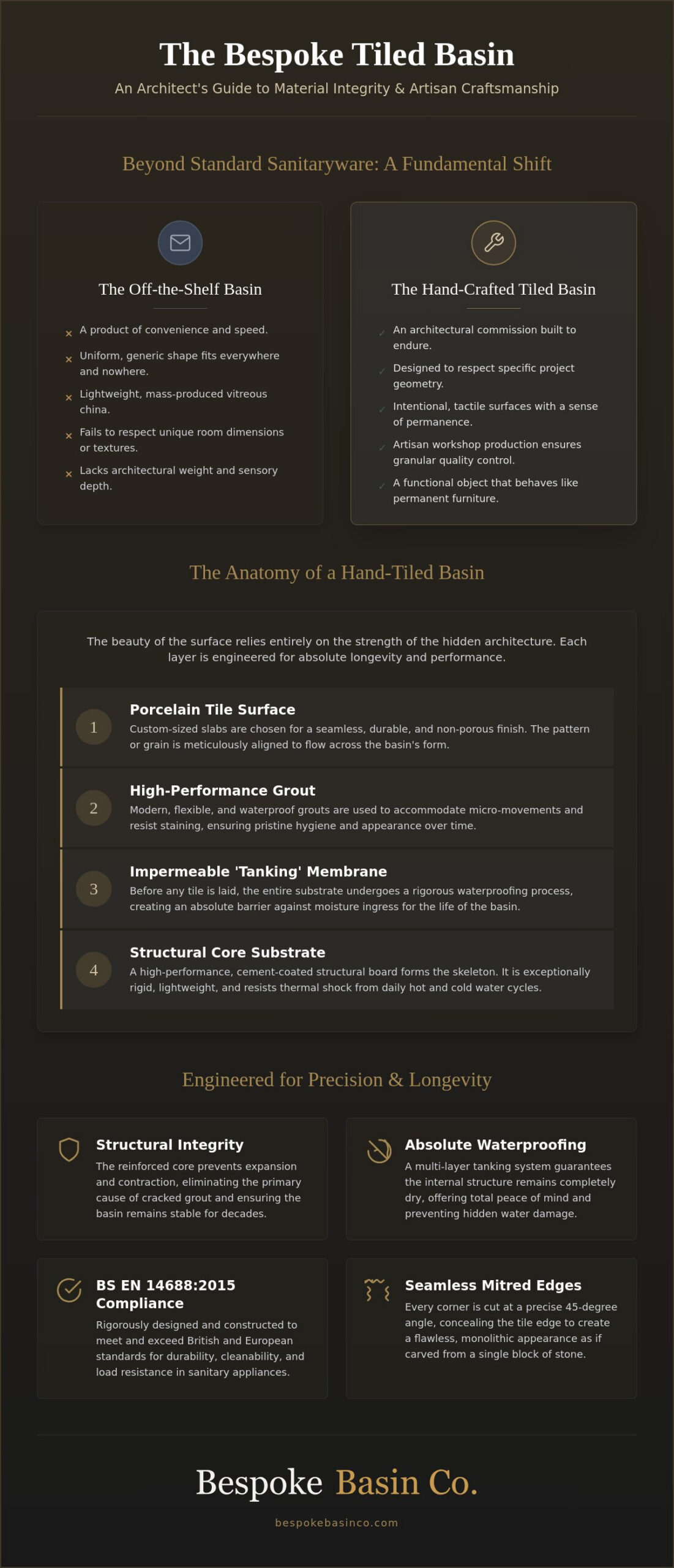
A standard basin is usually a product of convenience. It arrives in a box, a uniform shape of vitreous china designed to fit everywhere and nowhere in particular. In contrast, a hand crafted tiled sink is an architectural commission. It’s a bespoke vessel designed to respect the specific geometry of a luxury interior. This shift amongst designers marks a move away from mass-produced sanitaryware towards intentional, tactile surfaces that offer a sense of permanence. In the modern luxury bathroom, the basin has evolved. It is no longer a hidden utility; it’s a centrepiece that anchors the room.
British artisan production remains at the heart of this evolution. By keeping the manufacturing process within a dedicated workshop, we ensure that every cut, join, and grout line meets a standard that retail manufacturing cannot replicate. This is about quality control at the most granular level. It’s about the integrity of the object. When a basin is built by hand, it carries a weight and a presence that factory-moulded ceramic simply lacks. It becomes a permanent part of the building’s fabric.
The artisan studio. Slow making.
Retail products are born from speed. They’re built to be sold, not necessarily to endure the nuances of a custom space. The “slow making” philosophy of an artisan studio prioritises the object’s lifecycle. A master maker spends hours selecting and aligning custom-sized porcelain slabs, ensuring the grain or pattern flows seamlessly across the basin’s form. There are no shortcuts here. Unlike off-the-shelf items that often feel lightweight and generic, a bespoke tiled basin carries the weight of its making. This process avoids the common pitfalls of retail units, such as poor fitment or lack of character, by focusing on the raw honesty of the material.
Texture and design. The sensory bathroom.
Texture defines how we experience a space. Whilst sterile, smooth finishes have their place, they often lack the sensory depth required for high-end residential design. The tactile nature of a hand-tiled surface creates an emotional connection. It’s a nod to the ancient art of mosaic, where small, deliberate choices accumulate into a significant whole. These basins provide architectural weight. They feel rooted in the room. Whether you’re using a minimalist matt finish or a bold marble-effect porcelain, the result is a functional object that behaves like a piece of permanent furniture. It’s a way to use colour and pattern to define the character of a private home or a commercial development without sacrificing the practical needs of the user.
The engineering of a hand tiled vessel basin. Structural integrity.
A hand crafted tiled sink is only as durable as its hidden architecture. Precision. Longevity. The beauty of the surface relies entirely on the strength of the skeleton beneath. For a bespoke basin, the internal core must be exceptionally rigid yet lightweight enough for wall mounting. We utilise high-performance, cement-coated structural boards that resist the inevitable thermal shock of daily hot and cold water cycles. This substrate prevents the expansion and contraction that often leads to cracked grout in inferior builds. Unlike a standard vessel, an Organic Vessel Basin requires a core shaped with sculptural intent, demanding a higher degree of manual reinforcement to maintain its fluid lines.
Waterproofing is a matter of absolute truth. Before a single tile is laid, the entire substrate undergoes a rigorous tanking process. This creates an impermeable barrier, ensuring the internal skeleton remains dry for the life of the object. Our bespoke tiling service focuses on the exact alignment of every edge. Mitring is the precise process of cutting tile edges at a 45-degree angle to create a seamless, monolithic appearance where two planes meet. This technique hides the raw edge of the material, making the basin appear as though it were carved from a single block of stone. If you are planning a unique bathroom layout, you might consider how bespoke tiled basins can be tailored to your specific architectural requirements.
Substrate and core construction
The skeleton of a bespoke basin is typically constructed from high-density extruded polystyrene, reinforced with a polymer-modified cement mortar. This material is chosen for its moisture resistance and structural stability. It provides a stable foundation for the porcelain slabs, ensuring the basin can withstand the rigours of a busy household. The difference between a standard vessel and an organic vessel basin core lies in the complexity of the curves; the latter requires a meticulous, hand-carved approach to ensure the tiling sits perfectly against the substrate without voids or weak points.
The precision of porcelain slab integration
Custom-sized porcelain slabs are the preferred material for high-end tiled sinks due to their density and low porosity. They are nearly impervious to moisture, which is essential for hygiene in a wet environment. By using larger slabs, we minimise grout lines, creating a surface that is as easy to clean as it is beautiful. Managing these lines requires a master’s touch, ensuring they are narrow, consistent, and perfectly sealed. Tiling organic, curved forms remains one of the greatest technical challenges in the workshop, requiring each piece of porcelain to be hand-cut and finished with obsessive detail. This level of care ensures that even the most complex shapes feel cohesive and permanent.
Material palettes for artisan tiled basins. Porcelain and stone.
The choice of material is the foundation of the artisan journey. It defines the tactile experience of the room. A hand crafted tiled sink can be finished in either porcelain or natural stone, each offering a distinct dialogue with the surrounding architecture. Porcelain slabs provide technical superiority through their density and precision. Natural stone, however, offers a unique connection to the earth, grounded in history. This selection process is about more than just colour; it’s about how the object occupies space and how it responds to light.
Designers frequently specify porcelain for its immense aesthetic range. It can replicate the dramatic, sweeping veining of Calacatta marble or provide a quiet, minimalist matt finish for a contemporary project. This versatility allows for perfect colour-matching across a bathroom suite. By using the same custom-sized porcelain slabs for both the walls and the basin, you achieve a seamless transition. The fixture no longer feels like an addition; it feels as though it grew out of the wall itself. This continuity is a hallmark of high-end British interiors where every detail is intentional.
A Travertine Vanity Unit serves as a robust partner to a hand-tiled basin. The porous, textured nature of travertine provides a grounded contrast to the clinical precision of porcelain; this combination bridges the gap between raw material and refined craft. It creates a space that feels permanent and rooted. Using stone in the vanity area adds a layer of sophistication that complements the manual labour involved in the tiling process. It’s a balance of textures that appeals to both the eyes and the hands.
The durability of high-fired porcelain tiles
Porcelain is fundamentally different from standard ceramic. It is fired at significantly higher temperatures, resulting in a material that’s nearly impervious to water and stains. In high-traffic environments, such as a boutique hotel or a busy family home, this resilience is vital. It resists scratches and the harshness of chemical cleaners whilst maintaining its finish for decades. Using large-format slabs allows the artisan to create a monolithic look. This reduces the visual noise of multiple grout lines and focuses the attention on the basin’s form and the integrity of the maker’s work.
Natural variations and organic vessel shapes
The beauty of a hand-crafted object often lies in its subtle imperfections. When constructing an Organic Vessel Basin, the material must follow the movement of the design. Natural stones like travertine offer an earthy, timeless quality that evolves with the home. These materials age gracefully, developing a soft patina that factory-made products cannot replicate. Choosing stone for an organic form emphasises the manual action of the workshop, ensuring the final object feels like a piece of sculpture rather than a mere utility. It’s a choice for those who value depth and the raw honesty of natural materials.
Specifying bespoke basins for British interiors. Practical considerations.
The transition from a design concept to a physical installation requires technical clarity. A hand crafted tiled sink is an architectural component, not a retail afterthought. For architects and interior designers, the specification must begin with the structural capacity of the room. Large bespoke basins, particularly those utilizing heavy porcelain slabs, demand reinforced sub-frames or load-bearing wall fixings. This is a matter of safety and permanence. When documenting the brief, it is essential to define the exact footprint of the basin to ensure it aligns with the existing tile grid of the room.
In many British homes, particularly period renovations, space is a finite resource. The integration of wall mounted tiled basins allows for a sense of floor continuity that makes smaller rooms feel expansive. This approach requires early coordination with plumbing contractors. Tap holes and waste outlets must be positioned with millimetre precision within the workshop environment. Attempting to modify a tiled vessel on-site is a risk to the material’s integrity. By pre-drilling these apertures during the manufacturing phase, we ensure a clean, sharp finish that standard plumbing tools cannot achieve on-site.
For projects requiring precise architectural integration, you can explore our full range of bespoke tiled basins to understand how these units adapt to varied environments.
Sizing and spatial requirements
Measuring for a custom-sized porcelain slab requires an understanding of the finished wall depth. A perfect “wall-to-wall” fitment is only possible when the basin is commissioned to account for the thickness of the adhesive and the wall tiles themselves. Whilst countertop vessels offer a sculptural focal point, fully integrated units provide a streamlined, easy-to-maintain surface. Designers should also consider ergonomics; bespoke commissions allow the basin height to be tailored specifically to the end-user, a luxury often ignored by mass-market manufacturers.
Maintenance and longevity of artisan surfaces
Artisan surfaces are built to endure, but they require the correct chemical foundation. We exclusively use high-quality epoxy resins for all grout lines. Unlike traditional cement-based grouts, epoxy is non-porous and resistant to the limescale build-up common in many UK water systems. This ensures the hygiene of the hand crafted tiled sink remains uncompromised over time. Professional installation by our studio team is highly recommended to guarantee that the tanking and structural supports are perfectly executed. This dedication to the “slow making” process results in a fixture that maintains its architectural weight for decades.
Commissioning your bespoke tiled sink. The artisan journey.
A commission is a partnership. It is a shared dialogue between the client, the designer, and the artisan studio. Unlike a retail transaction, commissioning a hand crafted tiled sink requires a commitment to the process of creation. This is a journey that values patience, where every decision—from the radius of a curve to the exact shade of a porcelain slab—is made with intention. At Bespoke Basin Co., we act as guardians of this process. We manage every stage from the initial spark of an idea to the final, physical installation in your home. This continuity ensures that the integrity of the design is never lost between the workshop and the site.
For developers and architects managing larger portfolios, the scale of the task requires a specific level of technical oversight. Our commercial project guide provides the necessary framework for integrating bespoke vessels into multi-unit luxury developments. Whether for a single private residence or a boutique hospitality project, the goal remains the same. We aim to create an object that serves as a long-term investment in the property’s architectural value. A bespoke basin is not a temporary fixture; it is a permanent statement of quality that remains relevant as the building ages.
From conceptual design to workshop production
The journey begins with an initial consultation to discuss material, colour, and form. We explore how the basin will occupy space and how it will interact with the light in the room. Once the concept is defined, we move into the technical drawing phase. Every millimetre is accounted for. These drawings serve as the anchor for the project, ensuring that plumbing outlets and structural supports align perfectly with your interior plans. Only after your approval does the “slow making” phase begin in our workshop. Here, the hand-tiled vessel starts to take shape through a series of deliberate, manual actions that prioritise depth over speed.
Professional installation and the final result
The final stage of the journey is as critical as the first. We avoid subcontracted labour entirely. Our in-house studio team handles the installation to ensure the finish is as perfect as the object itself. This hands-on approach prevents the common errors that occur when external contractors are unfamiliar with the nuances of bespoke tiling. The final handover is more than just a completion of work; it is the delivery of a unique, hand-crafted piece ready for decades of use. It is the raw honesty of manual labour transformed into a functional piece of art.
Commission your bespoke basin today and begin the process of creating a truly unique architectural feature for your interior.
Grounding your design. The permanence of bespoke craft.
A hand crafted tiled sink represents a definitive shift from the temporary to the permanent. It’s an architectural element that bridges the gap between furniture and utility, providing a tactile focus that standard ceramic cannot replicate. By understanding the structural core and the artistry of porcelain integration, you can specify a fixture that truly belongs to its environment. This is about more than aesthetics; it’s about creating a space that feels rooted and intentional.
Our artisan studio prioritises substance over speed. We specialise in custom-sized porcelain slabs and manage every stage in-house, from the first drawing to the final handover. Because we don’t subcontract, the integrity of your commission remains our personal responsibility. Our own dedicated team provides the expert installation required to ensure your basin remains a functional piece of art for decades to come.
Explore our collection of hand-crafted tiled vessels and start your commission to begin your journey toward a more intentional interior. We look forward to helping you ground your design in the raw honesty of natural materials and expert craft.
Frequently Asked Questions
Is a hand-tiled sink as durable as a standard ceramic basin?
A hand-tiled sink is equal to or exceeds the durability of ceramic when constructed with a reinforced structural core. Whilst standard ceramic can crack under impact, the combination of high-fired porcelain and a cement-coated substrate offers superior resilience. This engineering allows the basin to withstand daily thermal shock and structural stress without compromising the finish. It is a permanent fixture built for longevity.
Can I specify a custom size for my hand-crafted tiled sink?
Customisation is the primary reason for choosing a hand crafted tiled sink over a retail alternative. We can build to your exact millimetre requirements, whether you need a compact wall-mounted unit or a large double basin. This flexibility allows designers to integrate sanitaryware into non-standard alcoves or create seamless wall-to-wall installations that factory-moulded products cannot achieve.
How do I clean the grout lines in a tiled basin?
Cleaning grout lines is straightforward when using the high-performance epoxy resins we specify for every hand crafted tiled sink. Unlike traditional cement grout, epoxy is non-porous and resists the absorption of dirt or limescale. A simple wipe with a soft cloth and a neutral pH cleaner is usually sufficient to maintain the surface. You should avoid abrasive scouring pads to preserve the integrity of the porcelain finish.
Are these sinks suitable for high-traffic commercial washrooms?
These basins are exceptionally well-suited for high-traffic commercial environments such as boutique hotels or restaurants. Porcelain is nearly impervious to moisture and highly resistant to the staining and chemical cleaners common in public washrooms. The structural core provides the necessary weight and presence for a commercial setting, ensuring the fixture remains pristine despite frequent use.
Do I need a special vanity unit to support a hand-tiled vessel?
Large or heavy bespoke basins require a vanity unit or sub-frame capable of supporting their specific load-bearing weight. A Travertine Vanity Unit provides a robust, grounded foundation for a tiled vessel. For wall-mounted installations, we ensure the internal skeleton is compatible with reinforced brackets to maintain stability. It’s essential to confirm the wall’s structural capacity during the design phase.
What is the lead time for a bespoke basin commission in the UK?
The lead time for a bespoke commission reflects the intentional, slow making philosophy of our workshop. Every basin is built from scratch, requiring time for substrate curing, precise mitring, and the application of waterproof tanking. Whilst the duration depends on the complexity of the organic vessel forms, the process ensures that no detail is rushed. We provide a clear timeline following the initial design approval.
Can you match the sink tiles to my existing bathroom wall tiles?
We can tile your basin using the same porcelain slabs specified for your bathroom walls or floors. This creates a monolithic aesthetic where the basin appears to emerge from the building’s architecture. Matching materials in this way eliminates visual clutter and reinforces the sense of a custom, high-end interior. It is an effective method for achieving a seamless transition between surfaces.
Is professional installation included with a bespoke basin commission?
Professional installation is a standard part of our service to ensure the technical integrity of the final product. We do not use subcontracted labour. Our own studio team handles the fitting to guarantee that the waterproofing, plumbing alignments, and structural supports meet our uncompromising standards. This hands-on approach ensures the transition from workshop to bathroom is handled with the same care as the build itself.